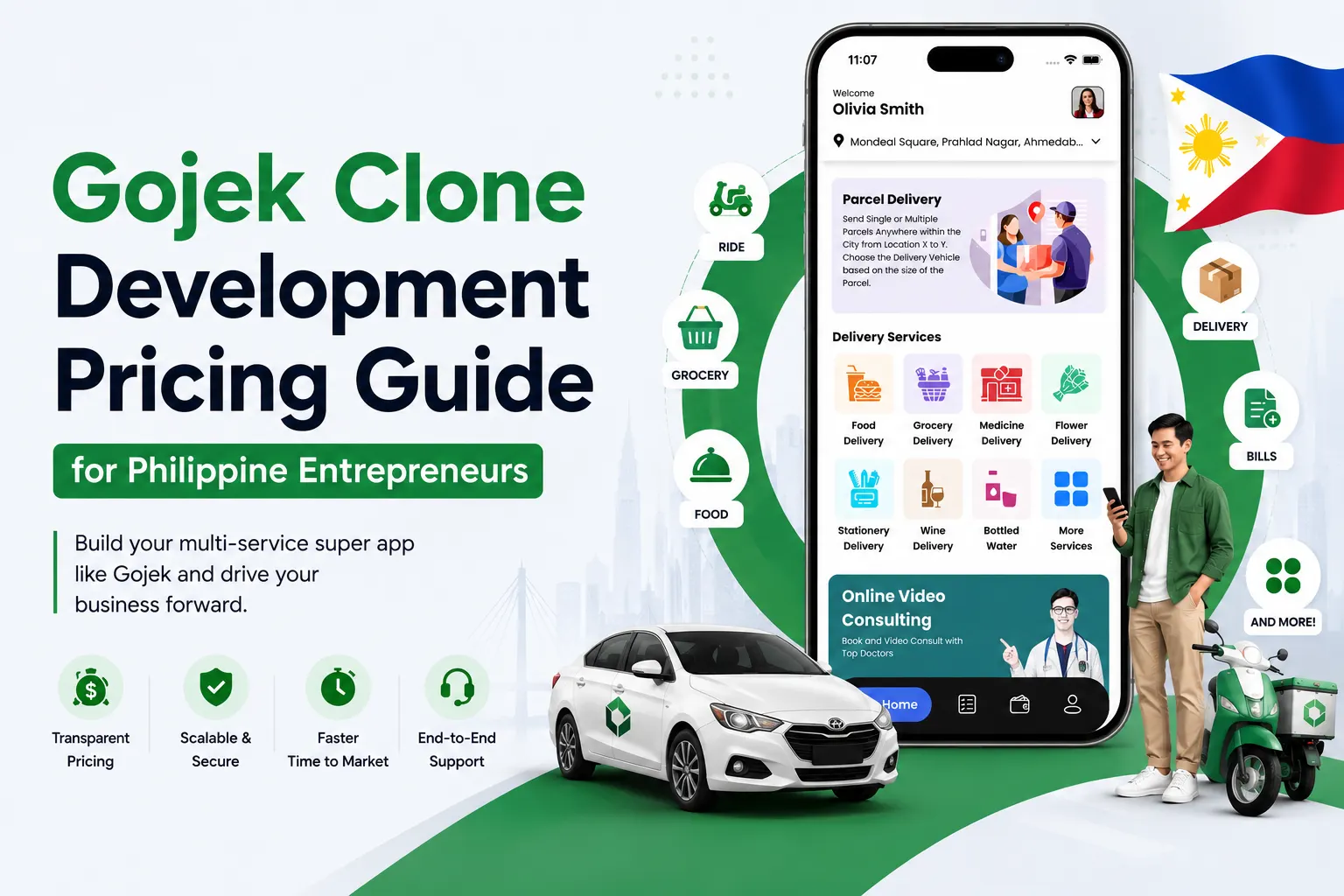
Southeast Asia is the hot zone when it comes to multi-service apps. The Philippines is also a major part of this growth wave. The country’s digital economy is witnessing a big boom in 2026. The online penetration at the start of 2026 was over 80%, and a high percentage of that is mobile.
The super app market is expanding at a CAGR of 25–30% through 2030 (Mobility Foresights, 2025). At the same time, the cybersecurity threats are also on the rise. As per the Philippines Cybersecurity report, over 624,000 accounts were compromised in the first quarter of 2026.
Grab dominates the multi-service app market, but the market is not saturated. There are plenty of opportunities for businesses to launch a Gojek Clone in the Philippines. This needs to be a highly secure, feature-rich, and AI-optimised solution.
This article provides insights into the cost of developing an app like Gojek in the Philippines.
What Is a Gojek Clone App?
Table of Contents
The Gojek clone app, as the name suggests, is a multi-service app like Gojek. It is similar in concept, model, style, and features to a great extent. However, it is a legally developed solution that does not involve copying source code.
The primary aim of this all-in-one app, like Gojek, is to provide users access to several on-demand verticals via a single app. Hence, this effectively means using a single login to access several services like ride-hailing, grocery, food delivery, home services, courier, and much more.
A white-label Gojek clone app is a good alternative to building a custom solution from the ground up. It is the quicker and more cost-effective method.
“A super app is not just a product — it is a business strategy. The platform that owns daily utility owns the customer.” — Kevin Kwek, Senior Partner, McKinsey & Company
How Much Does Gojek Clone App Development Cost in the Philippines
The cost to develop a multi-service app like Gojek in the Philippines ranges from $8,000 and $150,000+. The total development cost depends on several factors, like the depth of the feature and the services integrated.
The development approach also has a lot to do with it, since the cost of a white-label solution will typically be $8000 to $30,000. This approach also takes less time to develop: it can be ready to launch in 1-2 weeks, unlike the other option, which can take up to 18 months.
Factors That Determine Gojek Clone Development Cost
Several factors influence the cost of developing a Gojek Clone in the Philippines, as explained in detail here:
App Complexity & Feature Set
For firms that choose to custom-develop the app and build an MVP with minimal services and features, the cost will be low. However, the costs will rise as the number of features and services increases and AI features are also included.
Number of Services Integrated
This is essentially a multi-service app that includes services from various business verticals. Building the ride-hailing infrastructure itself is already complex. Adding other services like food delivery, home services, grocery delivery, and more further complicates the app and also affects the cost of development.
Tech Stack & Platform Choice
If you opt to build a custom solution, you get to choose the development method for the iOS and Android apps. Businesses can choose between hybrid development and native apps for iOS and Android (or for each platform). The hybrid solution is a more cost-effective one.
Development Approach: Custom vs. Ready-Made
There are several factors affecting businesses that choose the custom development approach. But there is another, more cost-effective option, which is opting for a ready-made solution.
The white-label multi-service app costs a fraction of the amount. Although businesses may have the option to select between the ready-made solutions with varying feature sets, they still cost a lot less.
UI/UX Design Complexity
For your multi–service app to be effective in the Philippines, it is vital that you customize it for the local market. Designing for the Filipino users will also affect the overall cost. The deeper the customization to localize it, the higher the cost.
Third-Party Integrations
Including third-party tools adds to the overall cost in terms of integration costs and licensing fees. This is typically for payment gateways, mapping services, push notifications, and analytical tools.
Post-Launch Support & Maintenance
A multi-service app also requires support and maintenance, which will also add to the overall cost.
Custom Development vs. Ready-Made Solution: A Cost Comparison
Building a super app from scratch is the equivalent of engineering a Formula 1 car to commute to work. It is an impressive feat, but there is a more rational option.
| Factor | Custom Development | White-Label Ready-Made |
| Time to Market | 18 Months | 1–2 weeks |
| Upfront Cost | $80,000 – $250,000+ | $8,000 – $80,000 |
| Code Ownership | Full | Full (with most vendors) |
| Customization | Unlimited | High (within framework) |
| Risk | High (untested architecture) | Low (battle-tested) |
| Scalability | Depends on the architecture | Pre-built for scale |
| Maintenance | Dedicated team required | Vendor-supported |
Entrepreneurs entering the on-demand market in the Philippines can gain a competitive advantage by choosing the white-label solution over custom multi-service app development. It will offer them strategic superiority, ideal market timing, and capital preservation.
This more than outweighs the theoretical advantages of a custom build, particularly before product-market fit is validated.
What Features Should Your Philippines Gojek Clone Include?
To be competitive in the Philippine market, it is vital to launch several verticals, such as a taxi app and grocery delivery. It is also essential to incorporate top-notch AI-Powered features to gain the upper edge.
Here are some essential features your app should include :
- Ride-hailing with real-time GPS tracking and dynamic fare calculation
- Food & grocery delivery with multi-restaurant/merchant management
- Home services (plumbers, electricians, cleaners, etc.)
- In-app wallet with GCash and Maya integration
- Multi-language support (English + Filipino)
- AI-powered dispatch and surge pricing engine
- Service bidding allows users to negotiate directly with providers
- Video consultations for telemedicine and tutoring
- Real-time analytics dashboard for admins and merchants
- Loyalty and referral programmes for user retention
Is a Gojek Clone Script Worth the Investment in the Philippines?
Considering the market opportunity and the consumer behavior, it is safe to say that businesses can benefit from developing a multi-service app like Gojek in the Philippines. They can also expect a good return on their investment.
“The brands that will define the next decade are the ones being built right now in markets that global giants have underserved.” — Reid Hoffman, Co-founder, LinkedIn.
There is a greater risk in the execution timing than in the market itself. Businesses can keep their initial costs low by opting for a white-label strategy.
Cube Taxi is a trusted Gojek Clone app development company that provides white-label solutions. Their product XJekPlus stands as one of the most comprehensive white-label super app solutions available globally.
It is designed to support over 100 on-demand services and is priced at a highly competitive rate that will not exhaust your budget.
Buy the Gojek Clone app from Cube Taxi today and gain the upper edge in a market where it is crucial to launch fast.
FAQs
1. What is the minimum cost to build a Gojek clone app in the Philippines?
A basic white-label Gojek clone with 2–5 services can be launched for as little as $8,000–$20,000 with an enterprise-ready, made-to-order solution. Costs scale significantly with the number of services, AI features, and custom development requirements.
2. How long does Gojek clone development take in the Philippines?
A white-label solution can be live on the App Store and Google Play in 1–2 weeks. Custom development from scratch typically requires 6–12 months, depending on feature complexity and team capacity.
3. What is the difference between a Gojek clone and a custom super app?
A Gojek clone is a pre-built, white-label platform that is branded and configured for your market, dramatically reducing cost and time to launch. A custom super app is engineered from scratch, offering maximum flexibility but at significantly higher cost and risk.
4. Which payment gateways work for a Gojek clone in the Philippines?
Most enterprise white-label solutions support GCash, Maya (formerly PayMaya), credit/debit cards, and in-app wallet functionality, all essential for the Philippine market’s payment ecosystem.
5. Can a Gojek clone compete with Grab in the Philippines?
Yes, particularly in Tier 2 and Tier 3 cities where Grab’s penetration remains limited. A localized super app with culturally relevant services, competitive commission structures, and hyperlocal partnerships can establish strong market positions in underserved Philippine regions.