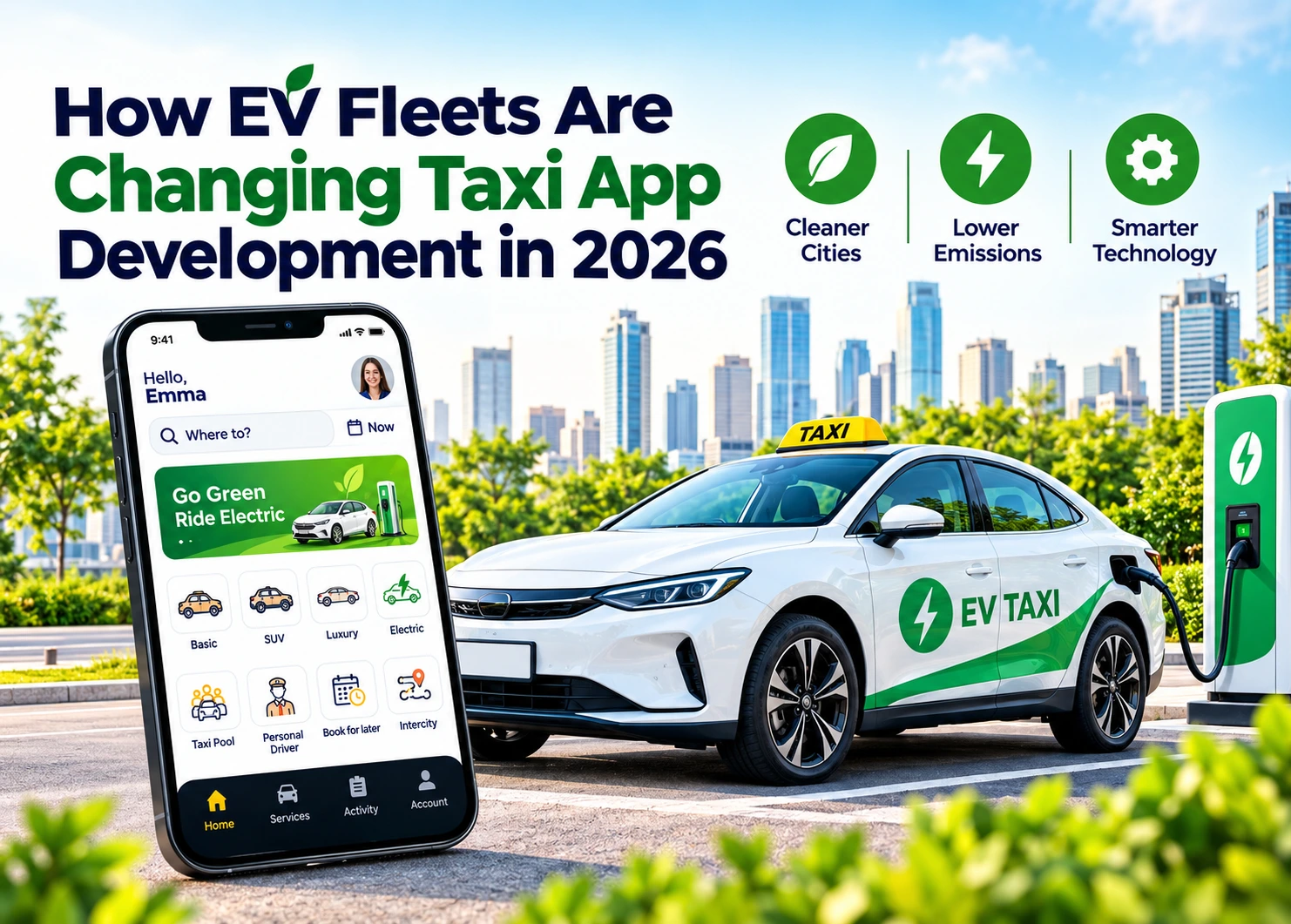
The taxi industry is about to enter a new era as electric vehicles transition from an emerging technology to a core part of commercial transportation. This evolution will have a direct impact on the way that operators manage their vehicles, drivers, and charging infrastructure. Taxi App Development in 2026 will need to evolve beyond passenger and driver management to embrace the realities of an electric vehicle (EV) fleet.
The statistics speak for themselves: According to the International Energy Agency (IEA), global EV sales surpassed 20 million in 2025, representing one out of every four new vehicles sold. The IEA predicts that global EV sales will reach approximately 23 million in 2026, or nearly 30% of overall vehicle sales.
This creates a new opportunity for the technology partners of taxi operators to build an application that goes beyond managing rides to embracing the full suite of EV management.
Why EV Fleets Are Disruptive for the Taxi Industry?
Table of Contents
An EV taxi fleet has the potential to reshape the economics and operations of a taxi business. That means that the technology partners of these businesses need to adapt to the new realities of the industry. EVs lend themselves to disruption in the high-utilization commercial vehicle space, where taxis operate for many hours a day.
A standard taxi platform focuses on answering these questions: Where is the driver?
An EV-focused platform needs to provide answers to these questions:
- How much battery does the vehicle have?
- How far can the vehicle go before needing to be charged?
- Where is the closest compatible charging station?
- How long will it take to charge the vehicle?
- Which driver should be assigned the next ride?
- When should the vehicle be charged?
The statistics underscore why this is a critical moment for Taxi App Development in 2026.
The Rise of the Electric Vehicle
The popularity of electric vehicles is driving a significant expansion of the technology ecosystem that supports them. In 2025, electric vehicle sales rose 20% to over 20 million vehicles worldwide, and the global electric vehicle fleet reached record levels. With approximately 5% of the world’s vehicles being electric, taxi operators and their technology partners are witnessing a major shift in the transportation sector.
The EV revolution is accelerating: The IEA reported that electric vehicle sales in emerging markets and developing economies excluding China grew by approximately 80% in 2025 compared to the previous year, with nearly 1.2 million electric vehicles sold.
Entrepreneurs should take note of this trend and rethink their approach to building a transportation platform, Battery information is becoming as valuable as location data.
Battery Information Is as Important as Location Data
Battery information is quickly becoming one of the most important metrics for an electric vehicle taxi. Drivers and operators need this information to ensure that the vehicle has enough power to reach its destination. A vehicle with only enough battery for two more short trips should not be assigned a five-mile ride.
EV fleet management needs to be integrated into the fabric of daily operations at the level of the individual vehicle.
Smart EV Charging Increases Utilization
Charging an electric vehicle is a fundamentally different process than filling a gas tank. A gas station stop can take minutes, but the logistics of EV charging can dictate the entire workflow of a taxi business. An intelligent platform can allow operators to make smart decisions about when and where vehicles should be charged, based on the needs of the drivers and the health of the battery. For example, the platform could:
While there is low demand for rides: Recommend that drivers with low battery levels charge their vehicles.
- Before peak hours: Prioritize vehicles with fully charged batteries for assignment.
- During peak hours: Avoid assigning multiple vehicles to charge at the same time.
- For scheduled rides: Ensure that the vehicle will have enough battery to fulfill the request.
This approach transforms EV fleet management into an intrinsic part of the platform.
Charging Infrastructure Shapes Route Planning
Route optimization has focused primarily on distance and time, but an EV-focused platform needs to consider another variable: battery consumption. An electric vehicle platform can integrate route information with battery data to recommend the most appropriate route for the vehicle and the driver.
For longer distances, the app could advise when and where to charge the vehicle, suggest alternative routes, and identify compatible charging stations along the way with estimated charging times.
This feature could become a compelling differentiator for an electric vehicle taxi application. It also has the potential to be a significant source of value for drivers.
EV Fleet Management as a Competitive Advantage
A taxi platform built around electric vehicles can be a powerful competitive advantage, but only if it is engineered correctly. In the wrong hands, an EV-focused application could create more problems than it solves. The complexities of EV charging, vehicle utilization, and driver scheduling can combine to offset the financial advantages of a lower-cost-per-mile vehicle. A centralized and integrated approach to EV taxi management could become a critical differentiator.
By analyzing the performance of vehicles, drivers, and routes, operators could identify the most efficient ways to improve utilization. A well-designed platform could help operators get the most out of their electric vehicles.
What Does the Future of Taxi App Development Look Like?
The future of Taxi App Development in 2026 looks a lot like the past, except with electric vehicles. A taxi platform built around electric vehicles will need to consider a wider range of factors when assigning rides and managing drivers.
It is not that every taxi needs to be electric, but rather that forward-thinking operators want to ensure that their technology partners are prepared to support their long-term needs.
The most successful platforms will integrate electric vehicles, battery management, charging logistics, convenient payment options, and a host of other features into a single intuitive interface.
Conclusion
The rise of the electric vehicle requires more than a few modifications to a standard ride-hailing application. An experienced Mobile App Development Company can create or customize a solution that powers every element of the business, from customer booking and driver availability to battery management, charging logistics, and financial analytics. Regardless of whether a business plans to launch a new electric taxi service or update an existing Taxi App Development platform, the right technology partner can support its needs.
Frequently Asked Question
1. Why does an EV taxi fleet require different app features?
An EV taxi fleet requires additional information beyond driver location, including battery level, range, charging recommendations, and charging station availability. These details could impact driver availability, route optimization, and vehicle utilization.
2. Can an existing taxi booking platform be upgraded for electric vehicles?
A developer can upgrade an existing taxi booking platform to support electric vehicles by adding features such as battery management, charging-station recommendations, EV-specific ride categories, and intelligent EV-specific scheduling.
3. Is an electric taxi app useful for a small taxi business?
An electric taxi app can be useful for a small taxi business, especially as it makes the transition to an electric vehicle fleet. A taxi application can support a mixed EV/combustion vehicle fleet and prepare the operator for higher rates of EV utilization.
4. How can an electric ride-hailing platform reduce operational problems?
An electric ride-hailing platform can reduce operational problems by leveraging the power of battery data, scheduling, route optimization, and predictive analytics.
5. What should businesses prioritize during EV-focused ride-hailing app development?
Businesses should prioritize reliable booking, battery management, charging logistics, intelligent vehicle scheduling, driver tools, fleet analytics, and overall scalability. The technology should address operational challenges rather than simply promoting the concept of electric vehicles.