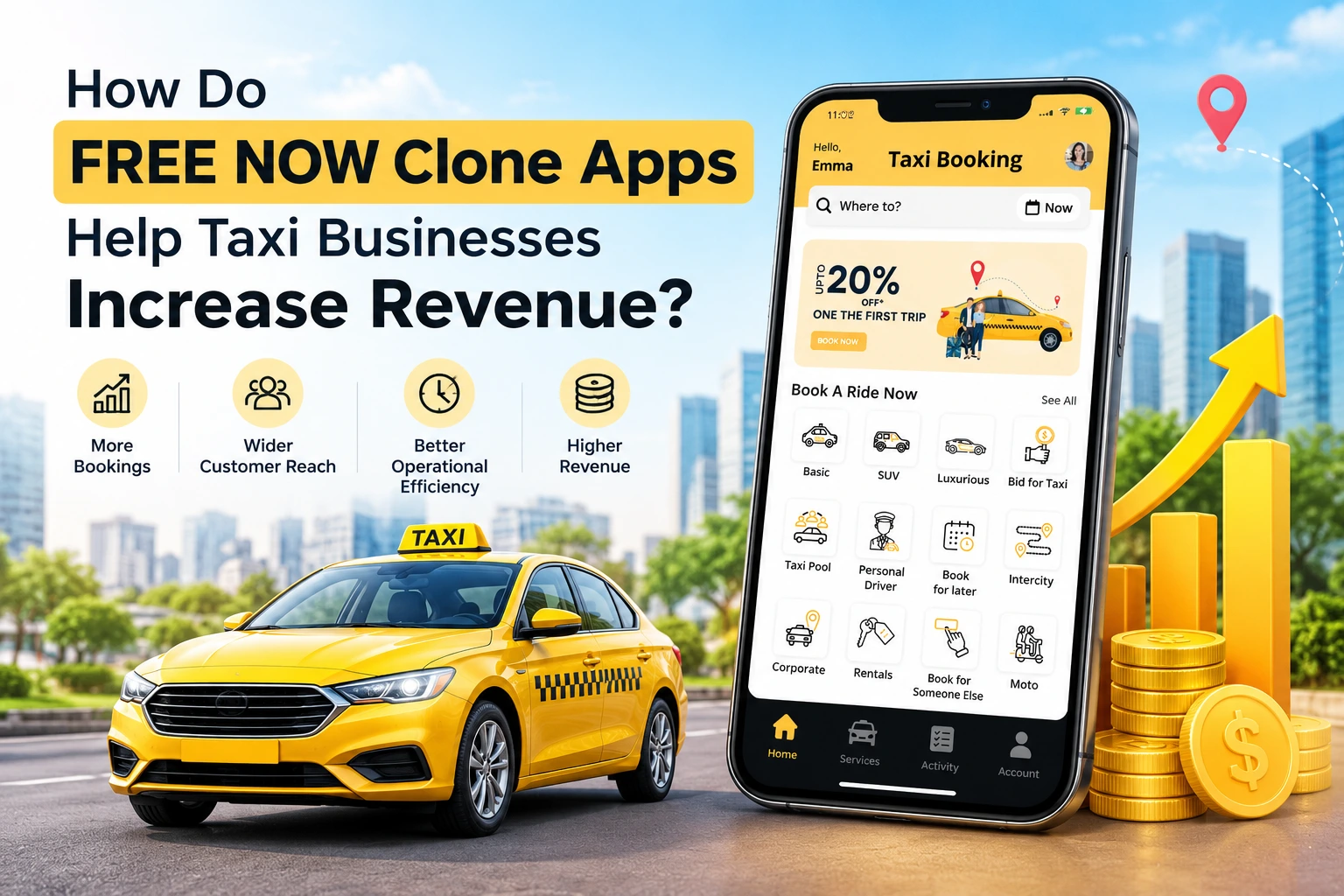
The businesses operating in the on-demand taxi sector need much more than just having a steady inflow of bookings to make profits. They need effective methods of dispatching taxi services, prices that can be flexible, payment methods that can be relied upon, as well as strategies for winning over and retaining loyal customers.
A FREE NOW clone can serve as the first step for businesses planning a digital taxi booking platform that would encompass all of its requirements to support their ride-hailing goals.
Through its convenient application, taxi operators will be able to connect riders and taxi drivers in the best manner, reducing manual work and opening new opportunities for increasing their revenues at the same time.
Yet, it is crucial to select the correct business model, define the local market, and make sure that the operating costs are under control in order for the business to be able to maintain profitability in the long run.
Reach More Customers Through Digital Bookings
Table of Contents
Traditional taxi businesses rely on telephone communication, potential pickups from the street, as well as a pre-existing clientele network. These methods often restrict the visibility they could potentially have and make it difficult to manage bookings during peak times.
A FREE NOW Clone app can help them broaden the booking range, as riders will have the ability to order rides via their smartphones. Possible functions that can assist in achieving a convenient process include real-time location tracking of drivers, booking notifications, and fare estimates.
Online booking options allow taxi operators to target those riders who prefer to plan their journey via the internet instead of simply waiting or searching for an available taxi. More efficient methods of operation can result in more trips being completed and, in turn, greater earning potential for both drivers and operators.
Choose a Profitable Taxi App Revenue Model
A clearly defined taxi app revenue model represents an opportunity for operators to learn more about each completed ride, contributing to the income of the business. Instead of relying on one source of income, taxi platforms have the chance to utilize various revenue channels, considering the characteristics of the market and riders.
| Cost area | What to evaluate |
| Software development | Initial setup, customization, and feature scope |
| Third-party services | Navigation, chatting, payment processing, and website hosting |
| Business operations | Staff, support functions, and provider onboarding |
| Marketing | Promotions, collaborations, and securing riders |
| Maintenance | Updates, patch management, upkeep, and technical support mechanisms |
Each option has a different impact on rider demand, driver retention, and operational costs. A good pricing strategy should make it possible for the taxi app to remain competitive in terms of fares with a proper margin that ensure the sustainability of the business.
Improve Driver Utilization and Booking Efficiency
Inefficient dispatching, unnecessary waiting times, and missed requests can hinder the number of trips completed each day. The implementation of booking and dispatch tools can increase the number of coordinated trips completed by the operators.
A well-designed platform with GPS-based driver detection, notifications about bookings, and continuous status updates about trips will improve the daily operating process.
The requests will reach drivers according to their availability for trips and the distance from the riders. At the same time, the administrator in charge will receive more information concerning the active booking status.
These capabilities enable taxi business revenue growth since it is possible to receive more bookings without totally depending on overwhelming manual coordination. Visible improvements will depend on many factors like demand, availability of drivers, traffic conditions, and efficiencies of dispatch rules.
Encourage Repeat Bookings With a Better Customer Experience
Getting a new customer base is a costly process. Encouraging existing passengers to book again can help build a more stable revenue base.
The best taxi app features would include the ability to save addresses, view ride history, provide transparent fare estimates, give access to various payment methods, and allow the rating of the taxi services and contact with help desk representatives.
Along with this, it is also important to provide loyalty programs and promotional offers that motivate riders to use the services again, at the same time carefully managing costs. In addition, riders prefer to use taxi services again if the rides have always been reliable and fares have been communicated properly.
On the other hand, the operators have to monitor the cancellation rates as well as riders’ feedback and frequency of repeated bookings to identify and eliminate any service issues that can potentially lead to revenue loss in advance.
Expand With the Right Taxi Business Growth Strategies
The need for revenue growth may not necessarily require launching into more than one city immediately. It’s better to adopt a more cautious approach that will allow the taxi operators to test some of their platform solutions before rushing into additional investments.
Valuable taxi business growth strategies include partnership deals with hotels and corporate offices, introducing transfer services from and to airports, and providing ride-hailing services in unserved neighborhoods.
It would be a good idea for fleet operators to plan about providing business accounts or specialized transportation services in case there is enough demand for them.
Before expanding operations, businesses should first analyze their booking volume, whether or not drivers are being utilized well, customer acquisition expenses, and trip profit. It is sensible to introduce new services or regions when the current operation continues to provide a steady level of service quality and positive unit economics.
How V3Cube Supports Taxi App Development
V3Cube designs pre-built and customizable clone-app solutions that enable taxi businesses to create their own e-booking platform without the need to build all the core components from the beginning. The pre-built architecture can be an initial stage for businesses intending to have rider and driver applications as well as tools for booking and operational management.
By using FREE NOW Clone app Development services, businesses can assess the platform structure, which consists of real-time booking processes, and identify which functionalities should be modified for market needs. Depending on a particular project’s scope, it might lead to a reduction in the initial development efforts compared to developing a complete system from scratch.
Overall, the advantage of this is the ability to customize the platform for a certain operating model and implement an individual identity for each general action.
It is crucial to confirm the limits for customizing the selected package, payment and map integrations, source code or licensing terms, deployment costs, and maintenance support. For instance, ready-made solutions could be a very quick way to test and launch core booking functions as opposed to launching an entire custom project.
However, it is essential to stress again that the actual benefit of using such a solution will depend on the chosen solution package and the degree of customization required. Thus, it is a good idea to get a live demo of the solution with a detailed quotation presented in the contract.
What to Evaluate Before Launching
Platforms assist in revenue generation; however, achieving profit by solely having a software solution is not guaranteed. Taxi businesses should assess the following areas before launch:
Operating costs
This budget covers various expenses such as software, hosting, payment processing, promotion, customer support, and software maintenance.
Driver participation
Providing good commissions, understandable payment policies, and reliable support is important for getting drivers onto the platform.
Trust and compliance
Important points to be reviewed are verification of drivers, rider safety, personal data protection, insurance and local regulations.
Performance tracking
Measure the number of rides completed by drivers, average cost of one booking, frequency of bookings from the same riders, cancellations, and profit received from one trip.
A good ride hailing business model links those operational choices to reasonable revenue goals. Testing the platform in a defined area before expansion will identify pricing problems, service gaps, and rider needs, which ultimately limit financial risks.
Conclusion
A digital taxi solution allows businesses to enhance access to rider, manage drivers, encourage repeated bookings, and enhance income opportunities. If sustainable results are expected, the pricing model needs to be planned with variables considered; the service should be reliable, operational costs should be controlled, and performance must be regularly analyzed.
Ready-made and adaptable solutions provided by V3Cube are useful for taxi operators who are willing to start their digital operations with a practical foundation. They should compare the offered features, customization requirements, and total cost of ownership in order to determine if the solution is suitable for their revenue needs.
FAQs
Q1. Can a taxi clone app increase business revenue?
It can create possibilities to bring in new riders, ensure a smooth booking process, and create additional sources of revenue. The results depend on demand, prices, provided service’s quality, and the level of operational costs.
Q2. How does a taxi booking app earn money?
Common strategies are commissions on rides, fees for bookings, subscription of drivers, corporate accounts, plus premium service packages. The right choice depends on various aspects of the local market conditions.
Q3. Is a ready-made taxi app suitable for a small business?
A ready-made solution is a great option for businesses that want essential booking features without an extensive investment in the project. After that, package details and regular expenses of using software should be evaluated.
Q4. What features should a taxi booking platform include?
Essential capabilities commonly include passenger and driver apps, GPS tracking, booking management, fare calculation, payment options, notifications, ratings, and an administrative dashboard.