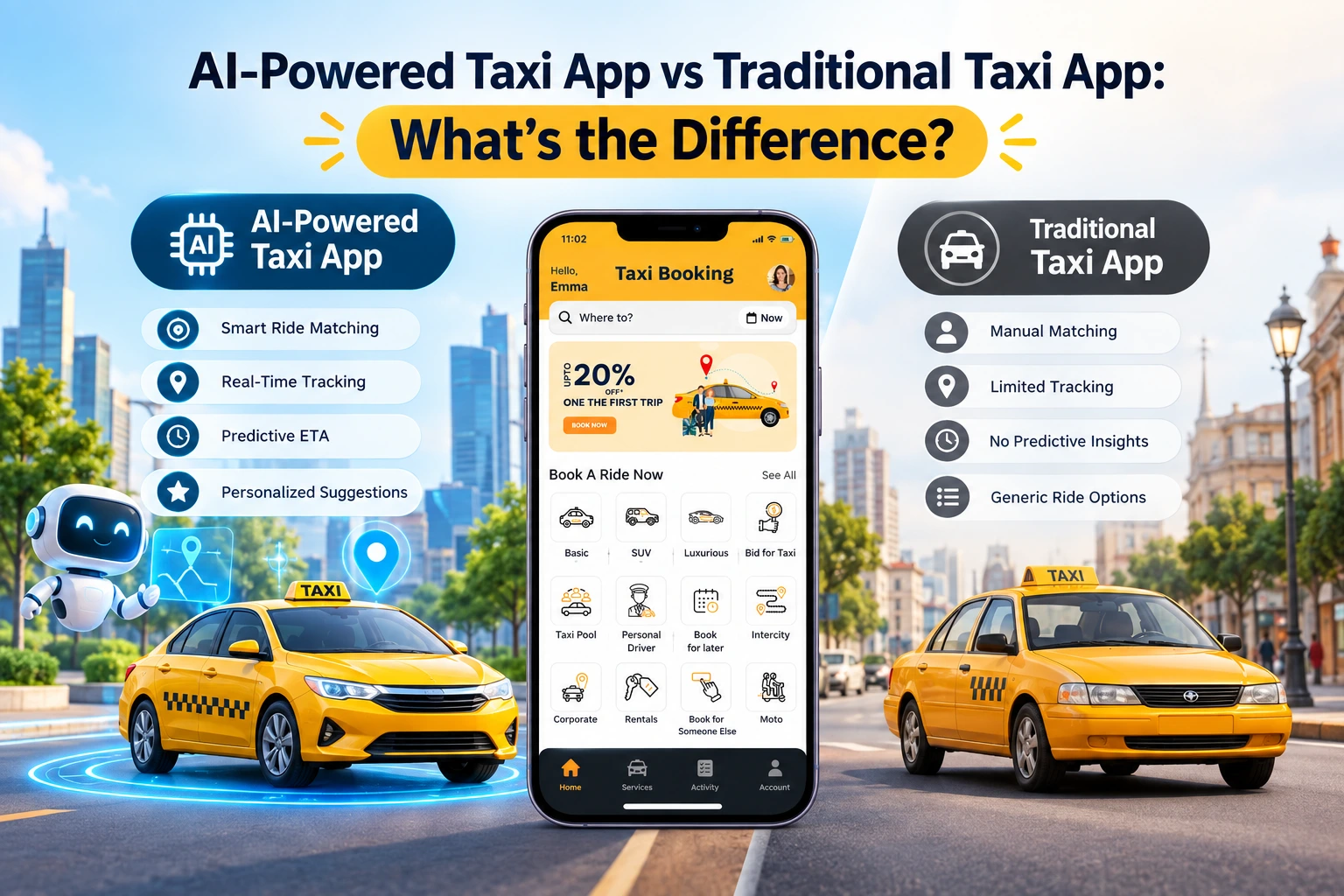
The initial impression of adding only AI to a booking app isn’t enough to distinguish an AI-Powered Taxi app vs traditional taxi application. The real differentiation between them comes in the form of taxi businesses handling pricing, driver management, customer service, safety, and daily operations.
Traditional taxi apps only digitize the booking process, while AI-powered taxi solutions increase efficiency in what is required for running the taxi business in general. Knowing the difference will assist taxi operators in making their decisions as to which technology they really need.
AI-Powered Taxi App vs Traditional Taxi App: Comparison
Table of Contents
| Point of Difference | Traditional Taxi App | AI-Powered Taxi App |
| Bookings | Standard digital booking | Digital booking with intelligent assistance |
| Pricing | Predefined rules | Data-based dynamic pricing |
| Driver Support | Ride requests and navigation | Ride request, navigation, demand insights |
| Route Planning | Standard GPS navigation | AI-assisted route optimization |
| Fraud Detection | Mainly manual monitoring | Automated risk detection |
| Driver Payouts | Manual or rule-based reports | Automated AI-supported reports |
| Promotions | Admin-selected campaigns | Behavior-based promotional assistance |
| Operations | More manual management | Greater automation |
1. Booking: Digital Requests vs Intelligent Assistance
The two systems are capable of providing an up-to-date taxi booking app. Riders can input their pickup and drop-off points, opt for a vehicle, request a ride, and monitor the driver.
The difference appears when the platform adds intelligent assistance.
In general terms, traditional systems adhere to the same fixed booking flow. An AI-driven system is capable of altering the procedure through the use of voice and text commands, automatic assistance, and a variety of reservation options.
2. Pricing: Fixed Rules vs Intelligent Pricing
Pricing is one of the clearest differences.
A conventional platform is likely to calculate fares using set standards across base fare, distance and time taken, category of vehicle, and peak hour charges.
This rule would work effectively in a predictable scenario but requires administrators to make changes in case of major differences in demand.
An AI taxi booking app can use additional real-time information. Demand, traffic, weather, availability, and time can be considered when calculating or adjusting fares.
3. Driver Management: Monitoring vs Assistance
A traditional system gives drivers the basic tools they need to accept bookings, navigate to passengers, complete trips, and view earnings.
An AI-powered platform can offer even more by spotting the areas where demand is going to increase and supply drivers with information about where and when they have better chances of receiving more bookings.
This can make a smart taxi app more useful for drivers because technology is not only being used to assign rides. It can also support their daily decisions.
V3Cube currently describes AI driver-earnings assistance that identifies areas and times where drivers may find more rides.
For a taxi operator, better driver utilization can also help improve vehicle availability during busy periods.
4. Route Planning: Navigation vs Optimization
GPS navigation is already a standard feature in most modern taxi applications. A driver can receive directions from the pickup location to the destination.
An intelligent taxi app can take this further by using route optimization to identify efficient routes based on available data.
This is essential because even minor advances in efficiency of routes can lead to not only lower travel time and fuel usage, but also more satisfied customers and productive drivers.
Traditional navigation tells the driver where to go. Intelligent route optimization can help determine which available route may be more efficient under current conditions.
V3Cube lists AI route optimization among the features of its current taxi platform.
5. Fraud and Safety: Manual Review vs Continuous Monitoring
Security is another important difference.
In a traditional system, administrators may identify suspicious accounts by reviewing complaints, cancellations, payment activity, or unusual behavior manually.
AI can continuously examine activity and flag patterns that may require attention.
For example, repeated cancellations, unusual transactions, suspicious account behavior, or abnormal booking patterns can be identified for further review.
V3Cube currently promotes AI-based risk and fraud detection that monitors rider and driver activity and flags potentially problematic behavior.
The need for human review is not negated by AI. Rather, administrators can use AI to help them concentrate their efforts on the processes that require more examination.
6. Business Operations: Manual Administration vs Automation
A traditional taxi booking software system can centralize bookings, users, drivers, payments, and reports. But administrators may still spend considerable time preparing reports and managing repetitive tasks. AI-powered systems can automate some of these activities.
Driver payout calculations are one example. Instead of manually checking every trip and calculating commissions, an AI-enabled system can generate reports based on completed rides and configured rules.
V3Cube currently offers AI-based driver payout reporting and automated weekly payout support as part of its AI feature set. This becomes increasingly useful as a taxi company grows from a small fleet to a much larger driver network.
7. Customer Engagement: Generic Promotions vs Personalized Offers
Traditional apps can provide discount codes and promotional campaigns, but administrators usually decide which customers receive them. AI can analyze customer behavior and help determine when particular offers may be more relevant.
For instance, a rider who has not used a taxi service for several weeks could be offered a type of promotion that is different from regular riders. This makes the process of marketing more specific and eliminates case when all riders are receiving the same discount offers.
V3Cube currently promotes AI-based automatic promo-code application based on customer behavior. The goal is not simply to provide more discounts. It is to make promotional spending more targeted.
What V3Cube Can Offer Beyond a Basic AI Taxi Solution
The market already has many platforms that add one or two AI features to a standard taxi application. V3Cube’s current offering takes a broader approach by combining AI with the core taxi platform.
Its solution includes AI dynamic pricing, AI fare generation, fraud detection, driver payout reports, route optimization, smart ride matching, business analytics, system monitoring, and driver earnings assistance. It also supports WhatsApp booking and voice or text-based booking assistance.
The platform also includes riders and driver apps, web panels, fleet management, manual dispatch, systems for administrators, and support for more than one currency and language.
Another useful aspect is that businesses do not necessarily have to choose between automation and conventional taxi features. The AI tools can work alongside standard booking, live tracking, scheduled rides, vehicle categories, and other everyday operations.
For businesses considering AI-powered taxi app development, this combination can provide a more complete foundation than adding isolated AI tools to an otherwise basic application.
Which Approach Makes More Sense for a Taxi Business?
The answer depends on the size, goals, and operating model of the business.
For a small operation that mainly requires online booking, real-time tracking, payments, and driver management functions, a traditional platform would perhaps fulfill its demands. In such a case, having sophisticated automation should not be a priority just because AI is available.
For a business expanding quickly, AI applications may be very useful as the number of riders, drivers, management needs, and operations increases in numbers. Automated reports, more flexible pricing, fraud detection, demand tracking, and routing optimizations would decrease the number of manual operations.
The best approach is therefore not about choosing technology because it sounds advanced. It is about selecting features that solve actual business problems.
Conclusion
The difference between an AI-powered taxi application and a traditional taxi application can be seen in the way each works. A traditional taxi application involves digital options in the taxi business but not artificial intelligence technologies, while AI taxi application is capable of analytical data processing, automation of routine tasks, as well as decision-making support.
AI can improve pricing, driver utilization, route planning, fraud detection, reporting, customer engagement, and business monitoring. But it should be introduced with a clear purpose.
When taxi businesses are planning the next technology investment, the priority should be to create a reliable platform for doing business and then incorporate AI where it can provide measurable outcomes.
FAQs
Is an AI-Powered Taxi App better than a Traditional Taxi App?
They fulfil various business purposes. The traditional application offers basic functions of the digital taxi, while the use of AI enables the implementation of automation, data analysis, and smart decision-making.
What features can AI add to a Taxi Booking App?
AI can support dynamic pricing, route optimization, fraud detection, driver earnings assistance, automated payouts, demand analysis, and personalized promotions.
Is AI-Powered Taxi App Development expensive?
The total cost depends on the features needed, integrations, platforms, personalisation, and AI features required for the app. Advanced AI modules increase development and implementation costs.
Can a traditional taxi business upgrade to an AI Taxi App?
Yes. A traditional taxi business can gradually introduce AI features such as smart pricing, automated reports, fraud detection, and intelligent routing as its requirements grow.
Does an AI Taxi App replace taxi administrators?
No. Actually, AI is used mainly to perform repetitive tasks and deliver necessary information. Administrators can still make significant decisions regarding operational processes, pricing, safety, etc.