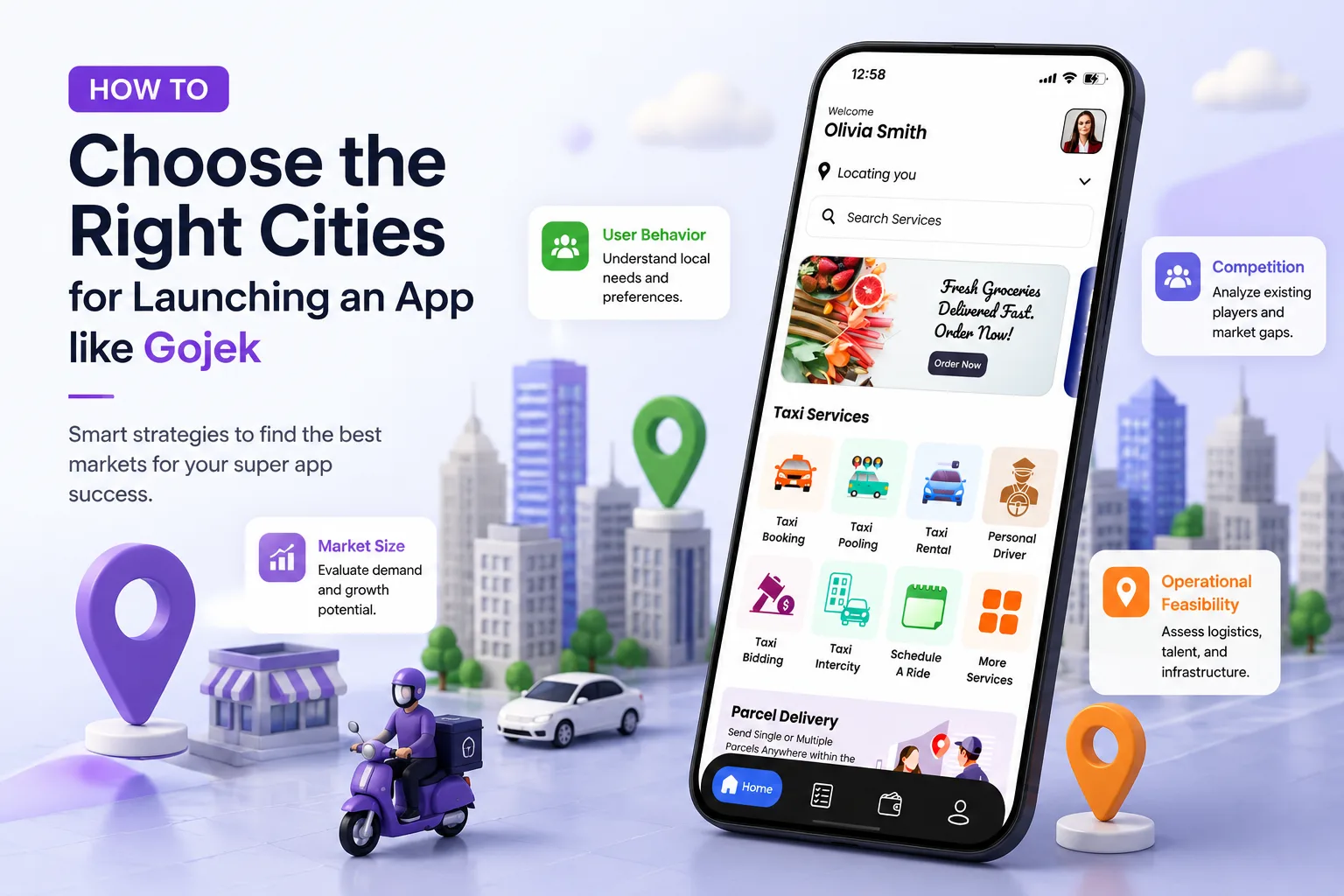
Introduction:
Table of Contents
For Gojek Clone market expansion, choosing the right city to launch your super app is not just a simple numbers game. Many founders simply open a spreadsheet, pick the biggest city in their country, and instantly call that their target market. But they are completely missing the real picture.
See, a massive population only tells you how many people could, in theory, download your platform. It tells you absolutely nothing about whether they will actually use it every single day across all your different services.
More importantly, it doesn’t guarantee you will have enough daily bookings to actually keep your local drivers and vendors happy. In reality, picking your launch city is not about the overall market size. It is purely about supply density.
You really need to completely shift your mindset on this before you even think about moving forward.
Why is City Selection More Consequential for a Gojek Clone App?
Launching a standard, single-service app is actually pretty forgiving. If you launch a simple food delivery app and realize you do not have enough restaurants, you only have one single problem to fix. But a super app is a completely different beast.
Even if you only launch the basic features like taxi booking, store deliveries, and home services, you are forced to build three completely separate networks of workers at the same time. You need reliable drivers, a wide variety of local store owners, and fully vetted service professionals.
See, each of these groups requires its own recruitment process, background checks, and a minimum number of active workers just to make the app function properly.
You can easily use geo-fencing to restrict your launch to one busy neighborhood instead of trying to cover the entire city from day one. But those tools are just safety nets. They absolutely cannot fix a fundamentally bad market.
At the end of the day, looking at how super apps perform globally is not just for show. It is actually a massive cheat code. It shows you exactly which combinations of local geography, tech-savviness, and daily consumer demand will actually keep a multiservice business alive long after the initial launch hype fades.
Evaluating the Factors That Actually Predict City Viability
Many different business founders have their own ideas or approaches when it comes to choosing a city to launch their Gojek clone, and almost all of them naturally look at the population size and internet access.
They are not wrong. See, checking the basic demographics is a perfect way to start, as it tells you how many people could theoretically use the app.
But success is not guaranteed just by picking the biggest city, and it’s because of many ever-changing reasons.
1. Underestimating the Local Workforce
For instance, many founders underestimate the local workforce and its influence, i.e., the informal market of local plumbers and maids who already get jobs through personal referrals. There are many brilliant startups with beautifully customized apps offering multiple services, but they are left to wonder why they cannot find enough local providers to keep the app running.
In reality, launching a super app actually requires a very critical and prepared mindset, as you are dealing with real-world habits, like how people actually prefer to pay.
2. Measuring Cash vs Wallet Strategy
If a city still relies heavily on cash, managing that money collection requires a completely different approach compared to a digital-first city. See, another thing founders underestimate is the competition, i.e., thinking that a city with other delivery or taxi apps is a bad choice.
3. Studying the Local Competition
Actually, a city with fragmented competitors is a perfect way to start, as the users are already familiar with the services and are looking for a new, better, more improved app that does it all in one place. Also, recruiting all these different workers takes a lot of time, so starting in a city where you already have a local network provides a great advantage.
Final Thoughts
Many different business founders have their own ideas or approaches when it comes to dealing with local competitors in a new city. They are not wrong to think that other apps validate the market. See, knowing that people already use delivery or taxi apps is a perfect way to start planning your business.
There are many brilliant startups with beautifully customized apps offering multi-services app, but they are left to wonder why they cannot get enough workers to actually join their platform. See, the software itself is a perfect way to start, as it is ready in two weeks and gives you all the tools you need, like geofencing, local languages, and a great admin panel.
But, having all these features will not save you if you choose a bad location. In the end, you have to carefully look at the local workforce, payment habits, and your own connections, i.e., making sure your first city actually funds your future growth instead of just quietly draining your money before the app finds its footing.