Introduction:
Table of Contents
Commissions work best in most single-service apps, as founders think it’s a great way to start the business. It is true, but it has its own downsides related to margins and incentives.
The Gojek model, which is the complete opposite of the single-service app model, makes sure that with each new booking, whether it’s related to ride-hailing or on-demand food delivery, it makes at least two revenue streams at the same time.
This super app concept is brought with the same idea and concept in a standard Gojek clone script which brings the same revenue model to its owner from day one.
There is also one more thing. People who want to make their own business with the help of super apps like Gojek think that making money on all kinds of revenue models should be activated since its launch.
Because leaving any of these revenue streams is like leaving real money on the table. What they don’t realize is that it all depends on the market, how many providers are available, and what kind of consumer behaviour attracts such services.
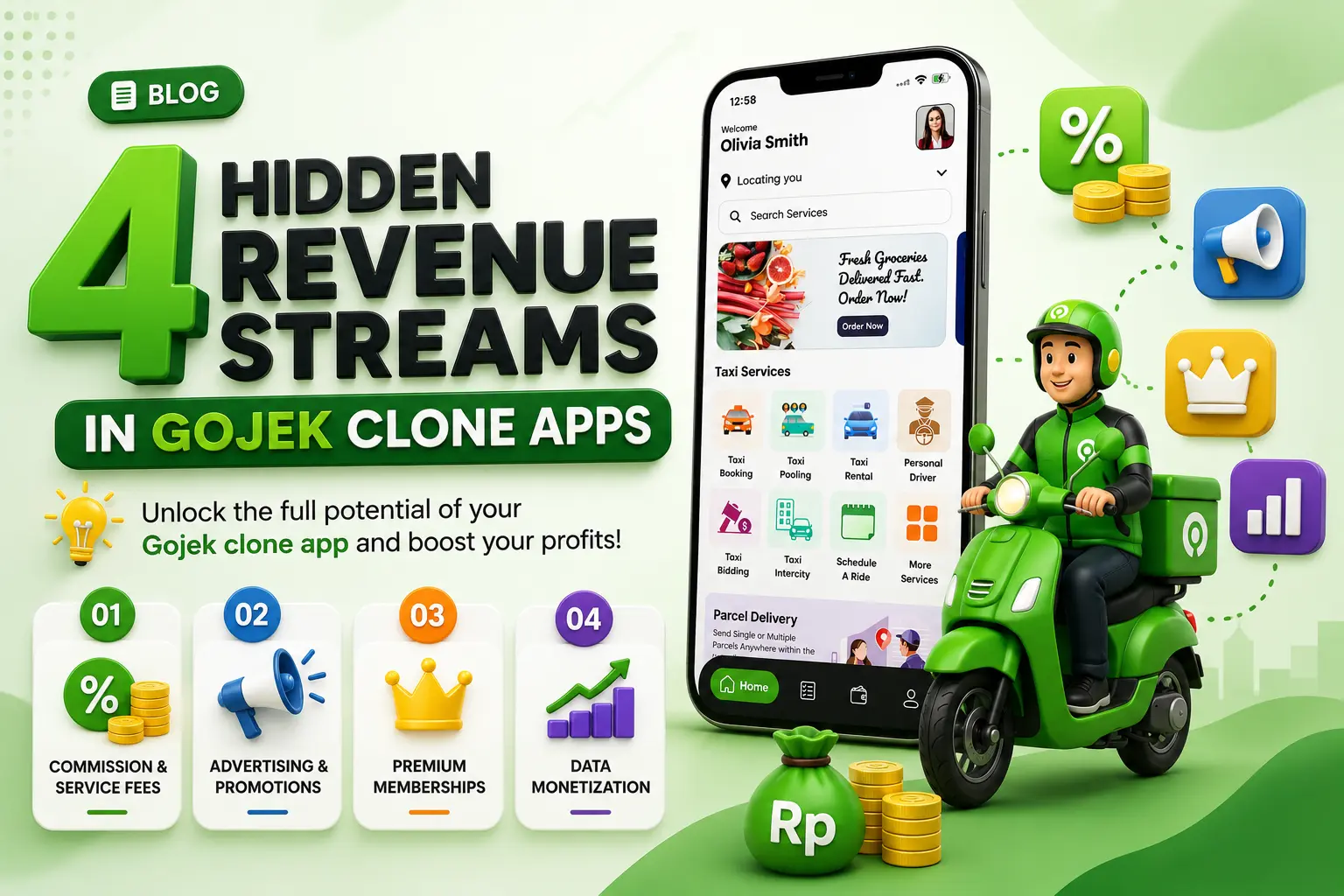
With that, here are four main streams you can unlock and how to approach each one of them.
Mapping the 4 Streams Inside Your Gojek Clone App
Most white-label platforms clearly state that their super app structure supports making money through commissions, subscription fees, surge pricing, delivery charges, service bidding fees, in-app ads, cancellation fees, featured listings, in-app wallet transaction fees, and B2B corporate channels. Each of these needs a straightforward breakdown.
1. Earning Commission Per Transaction
Every ride, food order, grocery delivery, handyman booking, and parcel dispatch that happens on your Gojek clone app makes a commission that you set up in the admin panel. The commission percentage varies depending on the category, meaning what you earn on a grocery order and what you earn on an electrician booking don’t have to be the exact same.
2. Charging Cancellation Fees
Users who cancel a booking that was already confirmed after a certain time limit have to pay a cancellation fee. This fee goes partially to the provider to make up for lost earnings and partially goes to the platform.
People tend to dismiss this as something minor. But when a platform processes thousands of bookings daily, the total amount adds up effectively, and the policy has an operational benefit by discouraging fake or casual bookings, which improves provider satisfaction and keeps them on the app.
The admin panel lets the platform owner control these settings directly without dealing with any code.
3. Earning on In-App Wallet Transactions
Having a digital wallet built into your Gojek clone app creates a closed payment system. Users can deposit money, pay for services, get cashback, and store their balances.
The platform benefits from people using the wallet because checkouts are faster and smoother, which increases how often people book, and the system automatically calculates commission and subscription fees from all wallet transactions to show in admin reports anytime.
More importantly, using the wallet increases the booking frequency quite a lot. Users who have a stored balance book the ride or service more often and with less hassle than users who have to enter their card details every single time.
The revenue impact from users booking more often adds up across all the other streams on this list.
4. Building a B2B Channel for Corporate Clients
Corporate Rides come as a built-in feature in the Taxi Booking section, and the admin panel lets you manage service areas and geofencing, which creates a good foundation for bringing in corporate clients who need regular staff transport or bulk delivery bookings.
Corporations, hospitals, logistics companies, and universities usually need these services in large numbers.
Just one mid-sized corporate client booking daily staff transport can make more revenue than a few hundred individual ride bookings in that same time, and corporate accounts stick around much longer effectively compared to individual consumers.
Building a Revenue Structure, Not Just Single Events
A user who puts money into the in-app wallet because of a cashback promotion, then places a food order that brings in a commission, triggers surge pricing, and picks a featured restaurant effectively creates four different ways to make money in just one session.
Stacking up these streams is what the Gojek business model actually gives you, and what a properly set up Gojek clone app delivers.
The money flow on the platform runs automatically, commission and subscription fees are auto-calculated, and the admin panel simply puts all of it together into one reporting dashboard. The real way to make a good profit doesn’t come from pushing one single stream way too much, but from increasing the number of streams a single user interacts with every week.
Your commission rate on a single ride matters a lot less than if that same user also uses your wallet, books a handyman through the bidding module, and pays their subscription fee without you prompting them.
Final Thoughts
A Gojek clone script gives you the money-making structure that took the original Gojek team several years and a lot of money to build. But what the script cannot do is replace real business thinking. Knowing which three to turn on in month one, which two to add in by month four, and which five to save for when your platform gets enough daily active users to actually make them useful. That step-by-step planning is the real work of building a super app business that has the formula to succeed.