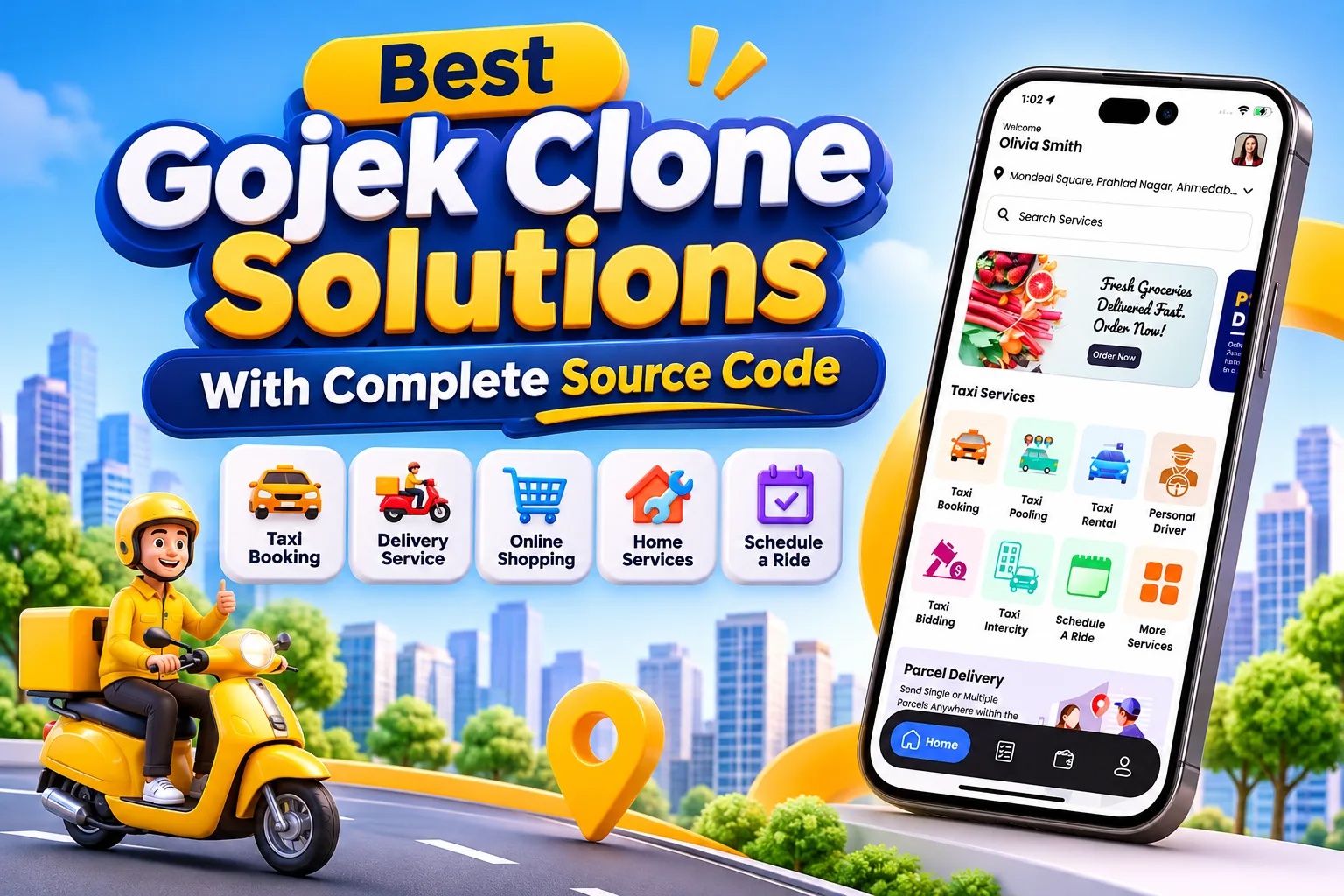
Selecting between Gojek Clone Companies involves more than merely considering the pricing, features, and delivery timelines. If a business wants to develop a multi-servicing platform, then they should also take into account the source code accessibility.
This will have an impact on how much control a business has over customization, maintenance, integrations, etc. That is why not every provider offers complete source code in their offered package to the buyer.
Some simply offer ready-made applications that can be minimally customized. Others may offer more access to the source code under specific licensing and ownership agreements.
The following guide describes the meaning of complete source code, what to check for, and how to compare providers like V3Cube before choosing one.
What Does Gojek Clone Source Code Include?
Table of Contents
Gojek Clone Source code is the term used to indicate all the underlying programming files that are used to run and operate the multi-service application. This contains the instructions for how the components of the platform will work.
It contains:
- Customer application code: The process of registration, searching for services, making bookings, accepting payment, and sending notifications takes place here.
- Code for the service provider application: Responsible for managing provider profiles, their availability, requests, and income.
- Driver or delivery application code: Takes care of task assigned, navigation, and status updates.
- Admin panel code: Manages the users, categories, commissions, bookings and reports.
- Backend code: Used for connecting the application with the servers, payment gateway, API, and database.
Different providers have different packages. It is important to check with the providers whether all the above-listed applications are included in the package or not, instead of assuming that using one application will give access to all the services.
Why Is Complete Source Code Important?
Being able to access all code in the codebase can mean that the application is more flexible than operating entirely off a closed or proprietary software package.
For example, a business can start off using a ride-hailing app, food delivery services, and a grocery shopping app and decide to introduce parcel delivery and different payment integrations later in the future.
Having the appropriate access to the relevant code can help the development team to implement the changes if the permissions and documentation are also available.
The key benefits are:
- Ability to customize: Developers are free to implement the necessary changes in supported workflows, interfaces, and business rules as per project requirements.
- Integration control: By using the existing codebase, you’ll be able to integrate other payment systems, mapping solutions, analytics, and/or any external services.
- Continuity of long-term development: The business can plan the development of features independently and does not have to depend on the original vendor’s readiness to release modifications to their software.
- Technical audit: The source system will provide the technical experts with comprehensive information about the app and its features.
Nevertheless, having access to the source code does not mean getting absolute ownership or the right to distribute the software.
What Should Complete Gojek Clone Source Code Contain?
The information obtained from the complete Gojek clone source code set should be assessed for the entire platform and not just the customer-facing application.
- Customer Application
- Provider Application
- Driver Application
- Admin Application
- Backend
- Documentation
It is essential that the business also verifies whether the code is available for Android, iOS, and web-based applications where these are part of the agreed package by the company.
How to Compare Gojek Clone Companies
Providers should not just base their evaluation on whether they are specifying source code availability but it must also be checked whether their delivery is comprehensive enough to satisfy clients.
The following comparison criteria can be used for this purpose.
- Code coverage means checking whether the service provider is supplying all agreed applications as well as backend components.
- Modification rights need to be confirmed. It should be determined whether the code can be changed by a third-party developer or by the client.
- Documentation should be provided on how to install the software and use it properly, along with the configuration details.
- Third-party software components must be examined to determine whether they are included in additional licenses.
- The cheaper package may not provide all essential modules, so it could mean a higher sum than expected is needed for this package. A detailed comparison of deliverables can provide a more realistic picture of the total investment.
A Questions About Ownership and Licensing
Various licensing procedures may be applied to multi-service application code. Terms of use may vary depending on the software’s usage and modification.
Some providers give complete access to the code and, at the same time, keep ownership of the original software. Other companies can provide more favorable conditions for its usage and modification rights as specified in the commercial agreement.
Some essential questions that need to be addressed are those such as:
1. Can the modifications to the code be carried out by the business’s own development team?
2. Is resale and redistribution legal?
3. Does the license restrict the use of the app in other organizations?
4. Are the third-party libraries or components self-contained?
5. Will the vendor provide updates and patches in the future?
6. Is there a provision explaining when technical support ends in the agreement?
It’s essential to know what goes under the term Gojek Clone source code ownership. Code access refers to different things, such as code usage rights and IP ownership.
Ready-Made and White-Label Solutions: What Is the Difference?
A Gojek Clone application is thought to provide a pre-existing application structure that entrepreneurs can leverage as a foundation for developing their multi-service platform.
A white label Gojek Clone solution takes this a step forward by enabling the platform to be launched under the name of the business and its own branding after the provider has customized it according to their requirements and licensing terms.
| Factor | Ready-made solution | White-label solution |
| Application structure | Existing platform | Existing platform |
| Branding | Depends on package | Business-specific branding |
| Customisation | Depends on available options | Usually includes branding and configuration |
| Source code | Depends on agreement | Must be confirmed separately |
| Ownership rights | Defined by licence | Defined by licence |
It is also noteworthy that a white label solution does not necessarily imply having complete source code and unrestricted ownership. It is required to do an independent auditing regarding these matters.
Why Consider V3Cube for Multi-Service App Development?
V3Cube provides businesses with pre-developed clone app solutions that can be adapted for multi-service platform use, saving a huge amount of time and effort. The quality of the offerings can be assessed by taking into account the applications, the backend components, and the administrative tools included in the proposed package.
When evaluating the various providers of such solutions, a factor that should be kept in mind is whether the solution covers the overall operational structure or is limited to offering the customer application only. V3Cube’s demos and discussions around the project can help understand more about available modules and options for customization and technical requirements attached to the product.
Businesses engaging in multi-service app development should make sure that they get information regarding source code delivery, the technologies in use, available documentation, third-party dependencies, and the rights to modify the source code.
It is advisable to evaluate V3Cube by the above-mentioned documented deliverables and the extent of technical assistance utilized in the project.
Conclusion
When selecting a Gojek clone provider, businesses must take into account more than just the offerings and costs. The supplier’s access to source code, licensing agreements, documentations, customisation options, technical support, and other aspects are equally important in the assessment of the long-term value of a particular solution.
When purchasing a solution in question, businesses have to ensure that they compare actual offerings with ownership terms before making a purchase. A detailed contract, as most of the required technology is already available, allows for the provision of the necessary customisation, maintenance, and upgrades of a multi-service platform.
FAQs
Do all Gojek clone providers offer complete source code?
Not necessarily. Certain providers provide limited access or a packaged application, whereas certain providers include broader code distribution.
Does complete source code mean full ownership?
Possibly. A provider may deliver the code and preserve ownership of intellectual property.
Can businesses customize a platform after receiving its source code?
Yes, if the license term permits changes and the codebase can support those changes.
Why is source code documentation important?
Documentation can help developers learn the organization of software, configure the software platform, fix troubleshoot issues, and perform future changes.