It is quite normal to think about rides, food delivery, or grocery last-mile logistics when a business owner wants to own a multi-service platform. These services are proven and very profitable in terms of startup launch, easily capable of running the business from end-to-end.
But over time niche services are making their way out of the hidden architecture of every well-designed Gojek clone. One of these services is called a delivery runner. A delivery runner is not simply just another courier guy who delivers food or other on-demand things under a different name. They are known to perform all kinds of personal services which are both hyperlocal in nature and can easily overcome most on-demand tasks.
In simple words, they are hired to solve problems that no fixed services are ever designed to address in the first place. A customer might need a consultation from a nearby doctor, wait in line at the government office, buy groceries from a known vendor, or collect laundry after all these things are done on the same day. No known service covers these amounts of request but a delivery runner easily does. And this is not just a small side hustle anymore. In 2026, the global errand running service market is crossing $25 billion, purely because people in cities are highly willing to pay just to save their time.
What Makes a Runner Different?
Table of Contents
Before getting into the seven roles, it is better to clear out one thing: delivery runners are valuable because they can easily handle unpredictable and out-of-the-box tasks that traditional delivery services simply fail to do.
Food delivery guys just follow a simple restaurant-to-door route. Courier guys take parcels between known addresses. And grocery agents mostly fulfill orders from a given catalog. All these types of services run under a very fixed, repeatable routine.
But runners don’t operate like this. They work in the middle of everyday unpredictable city life, where the need for a service comes first and what exactly the task is comes second. This difference is actually very important when you design your platform. When you invest your money in a White Label Gojek Clone that has a runner module, you are not simply adding another delivery category to the app. You are basically putting a bridge between every category you are already running right now, and every other category that you have not even built yet.
The 7 Unique Roles of a Delivery Runner
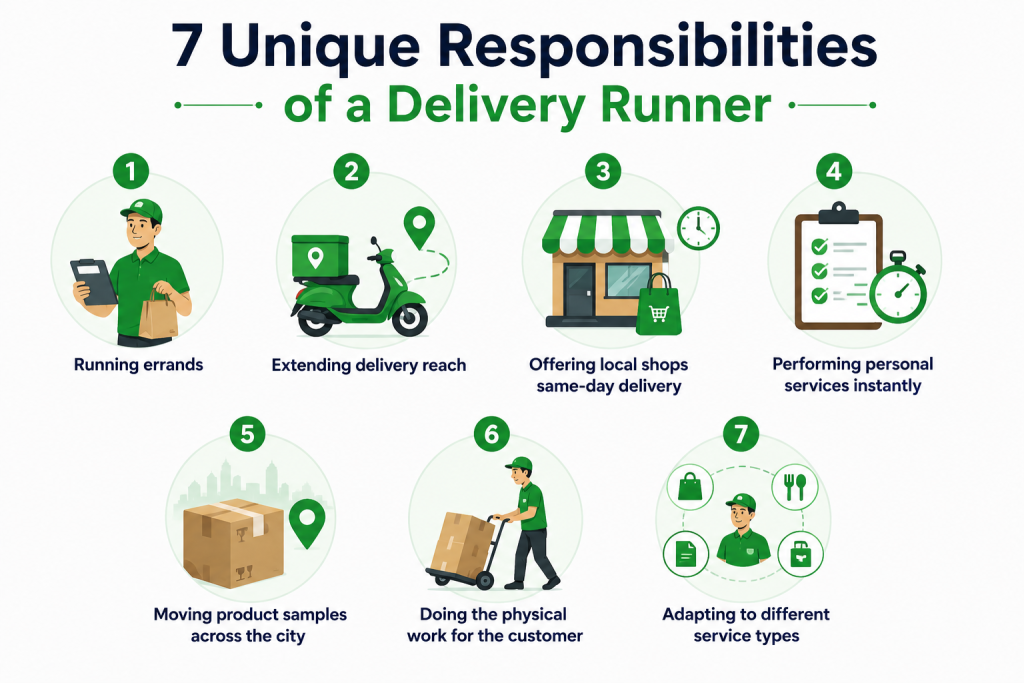
1. Running errands
At a very basic level, a delivery runner is just a guy who runs errands. People normally hire them when they need someone to physically be somewhere, like buying stuff from a local shop that is not on the app, collecting some documents, paying bills at an office, or picking up a birthday cake from a bakery. This kind of errand running gets repeat orders mostly because people have daily chores to deal with. Unlike delivering furniture which happens once in a blue moon, errands are a regular part of everyday life. App owners who have runners easily get a higher number of orders from their current users without doing anything extra to find new customers.
2. Extending delivery reach
Normal delivery apps usually ask for strict things like a proper sender address, receiver address, package size, or item value. These things easily ignore a large number of real delivery needs in the market. A customer who wants to send home-cooked meals to their parents living far away, or just pick up something they forgot at a friend’s place, has no known service to call. Runners simply extend this delivery reach into areas where normal courier guys cannot go. They handle informal and irregular things between people. By having this feature, a platform built on a Gojek clone script becomes highly useful in situations where all other standard apps fail to help the user.
3. Offering local shops same-day delivery
Local shop owners like tailors, repair guys, or florists are rarely found on big e-commerce platforms. They mostly run their business through phone calls, WhatsApp, and word of mouth. Their customers are loyal but they can only sell to people living nearby. A runner easily fills this gap for these shops by offering same-day delivery. A customer can just tell a runner to go to a known store, buy a specific thing, and deliver it in a few hours. This is very practical in nature, bringing local commerce into the runner’s daily job. For business owners, this creates an easy way to make money from local merchants who are not even registered partners, just by letting the runner finish the customer’s request.
4. Performing personal services instantly
City professionals usually need things done that are too small to hire an agency for, but too much to do on their own between office hours. Things like confirming a table at a restaurant, picking up a passport from the visa office, dropping papers at a law firm, or going to the mall to return a shirt. These are just personal services done at a very cheap price. Data from early 2026 shows that around 65% of people living in metro cities now heavily depend on getting these random tasks done within an hour. Runners who handle these daily tasks become very trusted by repeat users. That amount of trust creates way more app usage than a simple food delivery order ever will, simply because the customer is sharing real control over their daily schedule.
5. Moving product samples across the city
Big delivery companies take care of heavy freight, and small courier apps handle single parcels. But there is always a category in the middle, like a small business owner who wants to move ten product samples across the city, or someone managing an event who needs items from three different vendors before evening. Runners fill this gap in city logistics by acting as a highly flexible connector. They do not need a warehouse, multiple trucks, or a complex dispatch system. They just need a smartphone, the app, and knowing the city well. For platforms running on a Gojek clone app, this means the runner module can easily serve small businesses without needing to launch a completely different B2B delivery service.
6. Doing the physical work for the customer
Fulfilling a task is a bit bigger than just doing a delivery. It includes any physical work a customer wants done in the real world, whether it is waiting in a long line, submitting forms at a government office, or just doing a quick check and sending a photo back. When a runner takes this job, they are not just moving an item from one place to another. They are actually getting a process done for the customer. In simple words, this makes them work more like a virtual assistant instead of just a delivery driver. An app that provides this catches a lot of demand that would normally go to random freelancers or just end up wasting the customer’s own time.
7. Adapting to different service types
This is the most important part, and it clearly shows why runners are needed in a multi-service platform instead of a normal delivery app. Runners regularly do things that touch different service types in a single booking. A single trip for a runner might involve picking up a parcel, buying medicines, and dropping off house keys. That one simple request covers delivery, pharmacy, and daily chores all at the same time. This kind of cross-work makes runners the glue that holds a multi-service platform together. They clearly show what customers want that individual services cannot show alone, and they give business owners real data on what new services to launch next. Anyone building on a Gojek clone who understands this will use the runner module to get real insights rather than just treating it as a small extra feature.
Why Platform Operators Need to Take the Runner Module Seriously
Having multiple services is basically the main reason why a business owner wants to build a multi-service platform instead of just sticking to one single app. An app that provides ten different services simply gets ten different reasons from customers to use it. But when an app knows how to mix all these services together, it catches something much more valuable: customers relying on the platform for their daily life.
With the entire super app market crossing $120 billion globally in 2026, having multiple integrated services is no longer just a trend; it is a basic necessity to survive. Delivery runners easily make this happen a lot faster. Because their work can easily adapt to almost anything, they attract users who tend to order very often. These people do not come back to buy one specific item; they mostly return just because they know they have someone reliable to get their daily chores done. In simple words, this is completely different from a normal food delivery customer who just jumps between different apps looking for cheap discount codes.
Many app development companies have already built ready-made multi-service platforms just to help business owners easily make money from this whole setup. These Gojek clone apps usually come with built-in runner features, easy dispatching, earnings tracking, and a simple booking screen for the customers. So instead of wasting time and money trying to build a runner system from scratch, app owners can just launch it completely ready and put their real focus into getting more drivers on board and marketing the business locally.
Final Thoughts
A delivery runner is not just some small side feature for delivery. In a well-built multi-service app, runners easily take care of all the random things that standard services simply cannot handle. And they do this in a way that makes customers trust the app more, place more orders, and use the platform for almost everything.
FAQs
1. How is a runner different from a food delivery person?
A food or a grocery delivery person works within a set timeline and never moves out from a set of defined directions which starts from restaurant to door or from sender to receiver address. Meanwhile, runners are a bit different. They work on a time which isn’t set or defined by location. These non-standard tasks include purchase items, waiting in line, delivering to locations or completing a multi-step errand in a single trip.
2. Can runners support local businesses that are not present in the app?
Yes. A customer can find and order a runner to visit any local merchant for shopping purposes and take the product from there to deliver somewhere else. This kind of multi-role helps both the customer and the local business alike.
3. How does the runner model make money from app owners?
Revenue comes from service fees taken out per task, surge pricing when working through high-demand periods, subscription plans for those users that are frequent on the app usage, and indirect revenue from the data insights that runner makes about high and low demand in the market.