A taxi booking app is more than just a digital bridge connecting riders and drivers. The modern mobility business depends on an efficient transport system, and ride-hailing apps are an integral part of this. It delivers in the form of real-time tracking, personalised ride options, secure travel, and ease of availability.
The opening of the Gordi Howe International Bridge that connects Detroit (USA) with Windsor (Canada) opens a massive new cross-border route. It means new commuter routes and new adventures.
This is an industry where the demand patterns shift by the hour, with new and better routes continuing to be made. This increases the need for a state-of-the-art AI-dispatch system and a smart routing system that takes all the new traffic routes into consideration.
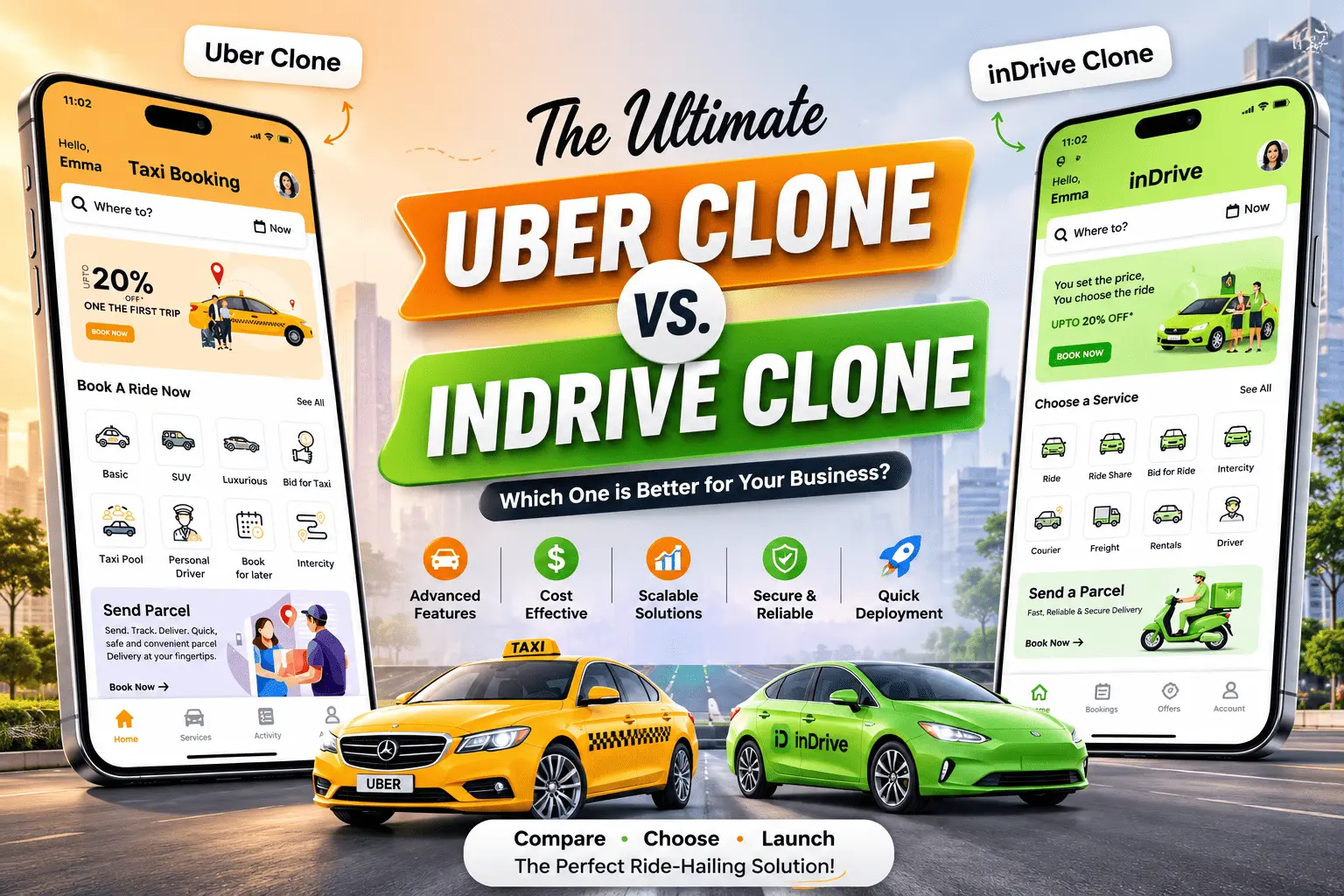
This article compares two of the most popular taxi clone apps and is an essential guide on Uber Clone vs. inDrive Clone.
Investing in a White-Label Taxi App
Table of Contents
Only the best taxi apps can ensure the least wait times, accurate ETAs, and smart routing. These numbers tell a good story:
Value of ride-hailing and taxi market in (Straits Research):
- 2025: $301.5 billion
- 2026: $335.7 billion (expected)
- 2034: $7692.8 billion (expected)
Almost every city already has a taxi solution. Some of the popular taxi businesses worldwide include Uber, inDrive, Bolt, DiDi, Lyft, Cabify, YandexGO, Careem, and Grab. Each city is unique and requires a different approach for setting up a good ride-hailing solution.
You can be forgiven for thinking the market is saturated. But this suggests just the opposite – in saying that the people are more than ready to accept a good taxi service. But it is vital one launches a good service fast.
Investing in a white-label taxi app allows you to do this. It costs a great deal less and can be launched within 2 weeks. The following sections shed light on the Uber Clone vs. inDrive Clone comparison.
What is an Uber Clone App?
This is a white-label taxi app that can be ready to launch in two weeks. The business model, features, and functionality are largely influenced by the popular giant Uber. The common components include a rider app, driver app, admin panel, website, and other additional panels & apps.
Uber’s origins lay in San Francisco, USA, where it was founded in 2009. It followed a top-down luxury & instant single-tap convenience vision. The pricing follows a centralized algorithm that also includes a dynamic surge rate. Uber initially targeted tech-savvy urban executives in San Francisco.
This is a proven business model that offers speed-to-market, cost efficiency, customization, and scalability. Some of the common features include AI-Dispatch, dynamic surge pricing, smart admin dashboard, smart routing, real-time tracking, and AI voice booking.
Uber currently has a global presence and operates in over 70 countries and 15,000 cities.
What is an inDrive Clone App?
This too is a white-label taxi app, and it is based on the popular Russian taxi app – inDrive. However, the clone app does not include the same source code. It is a perfectly legal app with the same business model and functionality as inDrive.
inDrive hails from Siberia, Russia, and originates from a vision of bottom-up fairness & resistance against price gouging cartels. They initially targeted price-sensitive commuters facing extreme weather in Siberia. It follows a decentralized peer-to-peer bidding system for pricing.
Some of the key features include a bidding & negotiation engine, a driver selection dashboard, and offers flexibility for multiple services.
inDrive also has a global presence. It operates in 48 countries and 1200 cities.
Uber Clone vs. inDrive Clone: Factors to Consider
The Uber clone and inDrive clone are two of the most popular white-label taxi clone apps. They are transforming urban mobility. For a business considering entering this market, it is hard to pick which taxi clone app to buy.
Here are several factors to consider for the Uber Clone vs. inDrive Clone debate:
Business Model:
The Uber clone implements a centralized, platform-driven model. Here, the automated algorithms handle the pricing and dispatching to ensure convenience to all concerned. On the other hand, the inDrive clone app implements a decentralized, peer-to-peer model. It involves the drivers and riders negotiating a fair fare. It is a more community-focused framework.
Revenue Generation:
The monetization strategy of the taxi clone like Uber includes high trip commissions and dynamic surge pricing that depends on various real-time factors like time, weather, events, and more. It also benefits from multi-service expansion. inDrive clones are more about volume-based revenue, a flat driver subscription, and in-app advertising.
Driver Acquisition:
The taxi clone app like inDrive has a lower platform fee; hence, the drivers gain higher pay. This tends to attract more drivers. At the same time, Uber clones have a higher commission rate, making these businesses work harder to retain the drivers.
Customer Experience:
Users on Uber-like clones can take advantage of one-tap booking, AI Voice booking, and also WhatsApp booking. The dispatch process is fully automated, and a highly accurate estimate is provided beforehand. With the interactive bidding on the inDrive clones, users get to assess several factors prior to booking, like the price, vehicle model, driver rating, and arrival time.
Scalability:
Those who invest in the Uber taxi clone can scale seamlessly across the globe since it is a fully automated infrastructure that is capable of handling high concurrent user demands with ease. inDrive clone’s manual fare bidding system allows it to scale rapidly in price-sensitive emerging markets.
Operational Costs:
The operational costs of inDrive clones are considerably lower due to a leaner technical architecture. This plays a big role in reducing customer support requests and server overheads. The cost to maintain the clones app like Uber is very high. It is a highly demanding system with predictive surge modeling and AI dispatch, and requires high capital to run.
Commission Structure:
Taxi clone apps based on the Uber model enforce a high, mandatory commission structure, and this is automatically deducted from the total fare. The inDrive one has a comparatively lower commission structure.
Pricing Mechanism:
The pricing for Uber-like clones relies on algorithmic dynamic pricing that factors in time, distance, traffic, and dynamic surge multipliers. However, the inDrive clone is quite different, with an open market negotiation engine where the riders and drivers negotiate the fare in real-time till they can strike a deal.
Flexibility & Transparency:
inDrive clones offer a high level of flexibility and maximum transparency by protecting the riders from sudden price surges. The Uber clone provides operational predictability and an upfront estimate; however, the fare is non-negotiable.
Third-Party Integration:
It is harder to integrate the inDrive taxi clone with third-party services, and this is mainly because of its unique pricing system.
Security:
Both the clone apps prioritize security to ensure passenger safety.
Market Penetration & User Base:
inDrive clones tend to be more appealing to the emerging markets where affordability and flexibility matter more. As for the Uber model taxi clones, it is more appealing to the mature, high-income Tier-1 market. Here, the riders prioritize rapid dispatch and premium vehicles.
FAQ
1. Which is better for a start-up: Uber Clone or inDrive Clone?
Which is better for start-ups depends on the market they are targeting and their business strategy. Uber clone is the ideal choice since it offers automated pricing, quick ride matching, and a scalable business model. If fare negotiations are common in your region, then the inDrive clone app is more suited for you; here, affordability is prioritized.
2. Is an Uber clone more profitable than the inDrive Clone?
There is no ‘general’ answer for this question since each model has its pros and cons. It is important for the business to set its goals and business objectives first. Both models are quite different; hence, it is important to compare both with your business requirements and select one that fits the best.
3. How much does it cost to buy a taxi clone app like Uber or inDrive?
The cost to a white-label taxi clone app is substantially lower than it is to build one from scratch. The cost of the Uber clone and inDrive clone will vary depending on where you purchase them from. However, they tend to cost less than $30,000.
4. Do the taxi clone apps like Uber & inDrive support additional services?
Yes. Taxi clone apps tend to support additional services like food delivery, parcel delivery, courier, bike rent, e-bike, etc. Uber and inDrive clones also support additional services, thus increasing the revenue generation opportunities.
Uber Clone vs. inDrive Clone: The Verdict
Buy a white-label Uber clone app from a well-established vendor like V3Cube if your goal is to build a ride-hailing platform for a metropolitan city. V3Cube is a clone app development company that has delivered over 1900 apps globally, and their AI-Powered taxi app – Uber is well suited to meet customer expectations.
In regions where people tend to negotiate the price, the white-label inDrive clone app from V3Cube, which has been delivering top-notch products for over two decades, might be the better option.