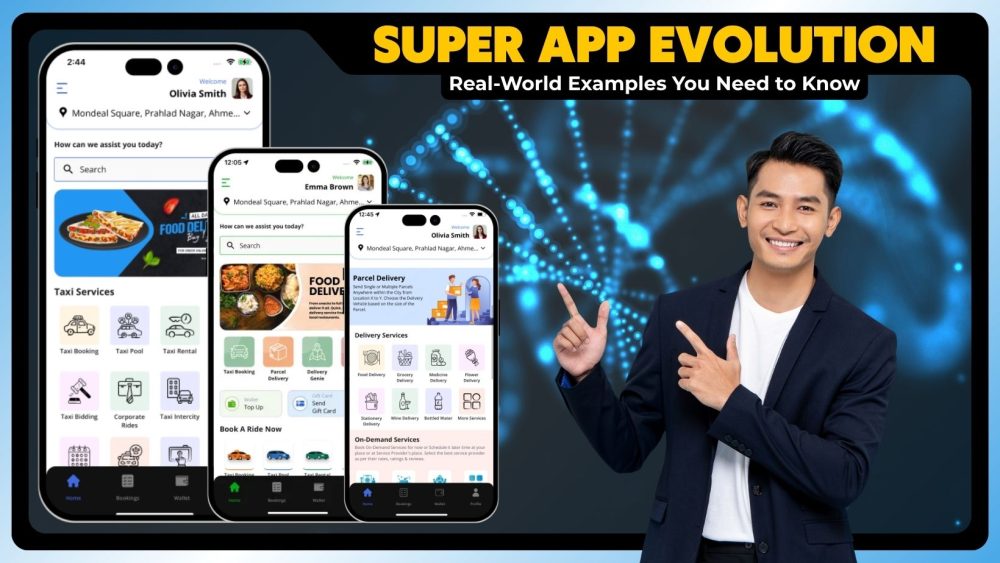
We live in an age where convenience rules. We want everything in one place, right at our fingertips. As smartphones become an extension of ourselves, users no longer want multiple apps cluttering their screens and eating up their phone memory. Instead, they crave something smarter, simpler, and more efficient.
With the increase in the use of smartphones, the app market has exploded. But this growth brought a new challenge app overload. Users found themselves switching between dozens of apps just to complete simple daily tasks like ordering food, booking a ride, or paying bills.
Then came the aha! Moment. Why not bring all these features under one roof? Why not create a single, unified platform where users could ride, shop, chat, pay, and even hire professionals all in one go? That’s where Super Apps walk in.
What Exactly is a Super App?
Table of Contents
A Super App is a mobile application that integrates a variety of services from payments and ride-hailing to shopping and professional bookings within one seamless interface. It’s like carrying an entire digital ecosystem in your pocket.
Users can perform multiple tasks without switching apps. And thanks to a universal login, they can access everything through a single account. Smooth, fast, and incredibly intuitive.
Behind the curtain, the secret sauce lies in modular architecture. Super Apps include mini apps, small, focused tools embedded within the main app that handle specific services like delivery, payments, or doctor consultations.
This structure allows businesses to add new features or partner with external service providers without rebuilding from scratch. Flexibility and scalability? Check and check.
Evolution of Super Apps: Born in Asia, Conquering the World
It all began in Asia, the heartland of mobile innovation.
In countries like China, Indonesia, and Singapore, smartphones quickly became the only way people accessed the internet. Limited storage and high data costs pushed developers to build efficient, multi-functional apps. The result? A revolution.
Apps like WeChat, Grab, and Gojek reshaped how users interacted with technology. Instead of downloading 10 different apps, people could do everything inside one. And soon, the concept of Super Apps spread across the globe, from Southeast Asia to the Middle East and beyond.
Let’s look at three prime examples that have become the poster children of this digital revolution.
Real-World Success Stories: Super Apps That Changed the Game
Gojek
This App has the power to increase sales by 10X in less time with multiple services. Gojek is an Indonesian On-Demand Platform that offers over 20 services, operating in Southeast Asian regions.
When you think about Super Apps, Gojek is one of the brightest stars in the sky.
Founded in Indonesia, Gojek started humbly as a ride-hailing platform. But its founders had a bigger vision. They saw drivers not just as transporters but as individuals capable of delivering goods, picking up groceries, and running errands.
So, they expanded. In 2015, Gojek introduced its Super App, merging ride-hailing, deliveries, and shopping. Soon after, it added food delivery, on-demand beauty services, entertainment booking, and even e-payments. Talk about an upgrade!
This expansion didn’t just benefit users. Drivers suddenly had multiple income streams, and businesses could reach customers faster than ever. Between 2016 and 2019, Gojek’s success skyrocketed, and it became Southeast Asia’s first “Mobile App” (a startup valued over $10 billion).
Today, Gojek offers more than 20 services across Southeast Asia, empowering millions of users and small businesses. So, if you’re looking for a textbook definition of a Super App, Gojek is one app, endless possibilities.
Grab
Want to know what tripling your customer reach looks like? Look no further than Grab, a Singaporean technology company that provides everyday services across 8 countries in Southeast Asia. The company started as a ride-hailing app, but it has expanded to encompass food delivery, grocery shopping, and payments.
Starting in 2012 as a simple ride-hailing app in Malaysia, Grab’s journey is a lesson in strategic evolution. Initially, its focus was clear connecting riders and drivers. But as competition heated up, Grab realized it needed to stand out.
Enter GrabExpress, a delivery service that laid the groundwork for expansion. Then came GrabPay, a digital wallet that transformed how people made transactions in-app. In 2018, Grab officially launched its Super App, combining transport, food delivery, grocery shopping, and payments into a single ecosystem.
But Grab didn’t stop there. The company introduced GrabPlatform, a suite of APIs allowing third-party businesses to integrate their services directly into the app. This move turned Grab into a platform of platforms, not just serving users, but empowering partners too.
Through collaborations like GrabFresh (in partnership with HappyFresh for on-demand grocery delivery), Grab cemented its position as an everyday essential for millions across eight Southeast Asian countries. What started as a ride-hailing app is now a full-fledged digital lifestyle hub, a perfect example of how Super Apps can redefine customer engagement and business growth.
Careem
This App has seen an increase in customers using multiple services in one interface. Careem, a Dubai-based brand that’s made waves across the Middle East and North Africa. Originally, Careem started in 2012 as a corporate car booking website. Slowly, it grew into a ride-hailing service that rivaled Uber so much so that Uber eventually acquired it.
But Careem’s story didn’t stop there.
In 2018, the company ventured into food delivery with Careem Now. However, the team soon realized that managing multiple standalone apps was cumbersome for users. The solution? Consolidation.
In 2020, Careem launched its Super App, uniting ride-hailing, food delivery, and digital payments in one smooth experience. This strategic move was a masterstroke. Careem saw a ninefold increase in customers using multiple services within the same interface. Today, Careem serves 48 million users across 12 countries and counting.
The company’s mission is clear, simplify people’s lives through technology. And with its super app approach, it’s doing exactly that.
What’s Next for Super Apps?
The Super App trend shows no signs of slowing down. We’re witnessing global expansion, with deeper AI integration promising enhanced personalization and efficiency. Expect a stronger focus on financial services and B2B solutions, though this will inevitably bring increased regulatory scrutiny. Emerging technologies like AR, VR, and even the metaverse could redefine the Super App experience entirely. Meanwhile, existing platforms are increasingly adopting “Super App-like” functionalities, blurring the lines between traditional apps and true Super Apps.
Conclusion
Super Apps aren’t just another passing trend they’re the future of how we live, work, and do business.
From Gojek and Grab to Careem, these pioneers have proven that when technology meets convenience, magic happens. They’ve reshaped economies, empowered local service providers, and made everyday life simpler for millions. For entrepreneurs and startups, the message is clear: if you want to stay ahead in today’s competitive market, it’s time to think super.
Launching your own Super App could be the smartest business move you make this decade. Instead of building multiple apps for different services, you can offer everything under one digital roof, just like the giants. All you need is the right Super App Development Company, one that offers a ready-made, customizable solution to get your business up and running quickly, without burning a hole in your pocket.
In a world where time is money and simplicity is power, Super Apps are leading the charge. They’re not just apps, they’re ecosystems. And the sooner you join the movement, the faster your business can ride this unstoppable digital wave.