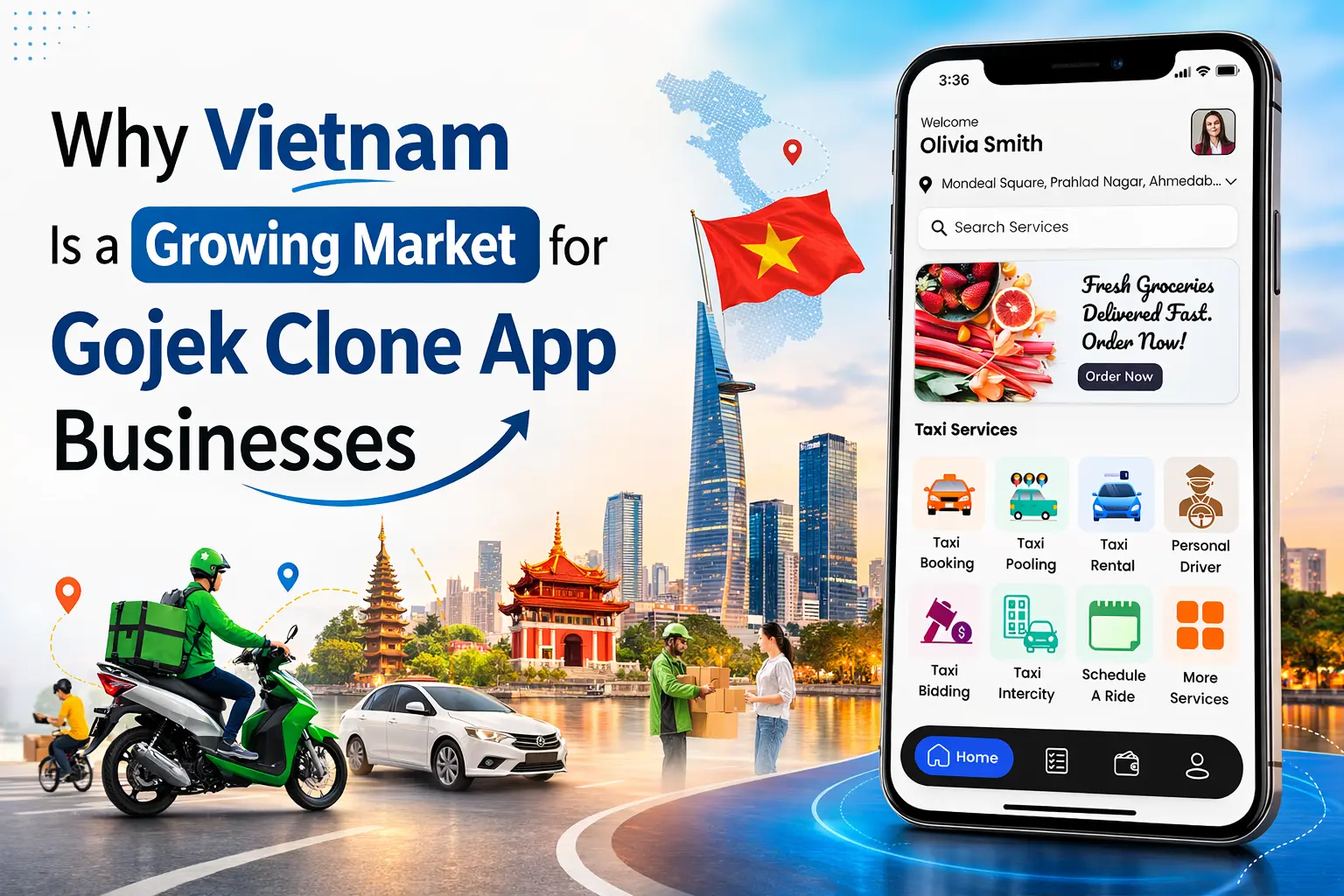
Introduction to the Rising Super App Economy in Vietnam
Table of Contents
Vietnam is rapidly developing into a super app economy. Many people are searching for super app development, and launching their own Multi Service App in Vietnam. This is because the audience for super app on-demand services is huge in Vietnam. A recent survey reported around 84 million people using smartphones in Vietnam, out of which 79.4 million people have a secure internet connection. The smartphone penetration shows the opportunity is huge while also showing the user behavior in the Vietnamese market.
Super app development in Vietnam is becoming easier with the evolution of technology and smart entrepreneurs are already taking advantage of it. If you’re someone who’s interested in a new business venture or an on-demand business looking forward to business growth. Take a seat, sip your coffee and note down as we learn about this growing opportunity.
Let’s cut to the chase and start with understanding the concept of Gojek clone apps.
Understanding the Concept of a Gojek Clone App
A Gojek clone app is a super app that combines multiple services on one platform. It connects the users with service providers, and nearby businesses who can provide them solutions to their different needs like ride-hailing, logistics, video consultations, plumbing, wiring, construction, home services, and many more. The Gojek clone app offers a suite of services which are daily or often used by consumers by digitally booking the services.
There are numerous examples of successful super apps worldwide. But in Vietnam, the market was organized via the support of Gojek and many other Gojek clone apps. While the market leader is still Grab and Gojek has withdrawn from the market in 2024 September, this support is one of the most important factors for the growth of the market for super app service businesses in Vietnam.
Key Factors Driving the Growth of On-Demand Apps in Vietnam
The high rate of smartphone penetration and market fragmentation is one of the crucial factors for the growth of Gojek-like multi service app in Vietnam. On top of that, people have adopted the new-gen payment methods like Zalopay and they’re demanding more convenient experiences. These are not just growth factors but also a clear descent of the shift in user behavior which can’t be ignored. Let’s understand in detail.
Market Fragmentation (Tushar Added)
While the market is very fragmented in terms of service connectivity, multi-service apps like Gojek have offered connectivity and convenience in transport, logistics, and payments. This ecosystem is highly attractive and people benefit from this daily in different ways. They get everything they need while in return paying for that convenience. This is exactly how the ride-hailing and delivery market grew up to $4 Billion in 2024.
Rapid Growth in Smartphone & Internet Penetration
The on-demand market in Vietnam grew rapidly after the introduction of smartphones and the internet in around 2010-2012. Companies like Xiaomi, Oppo, and Samsung sold good quality phones and the internet providers infiltrated the market with low cost internet. This resulted in a massive technology update and Super apps started to grow. Today, about 80 million people use high-speed internet which super app businesses in Vietnam benefit from.
Growing Digital Payment Adoption
With the emergence of mobile money, digital payments are part of daily life in Vietnam. Surveys report, 88% of the Vietnamese are going cashless and the adoption of QR codes have surged to about 106%. This shift makes the ecosystem more convenient with customers preferring to order online food and book rides through Gojek-like multi-service apps in Vietnam. They integrate these systems and make payment easier which ultimately accelerates the orders.
Increasing Demand for Convenience in Services
On-demand market of Vietnam has evolved in the past decade. With the tech upgrades, many Gojek clone apps have emerged and they’re setting new benchmarks for convenience. Today, your favorite item gets delivered to your doorstep with speed and care. This is the convenience which the Vietnamese market has grown upon.
Most Popular Services for a Multi Service App in Vietnam
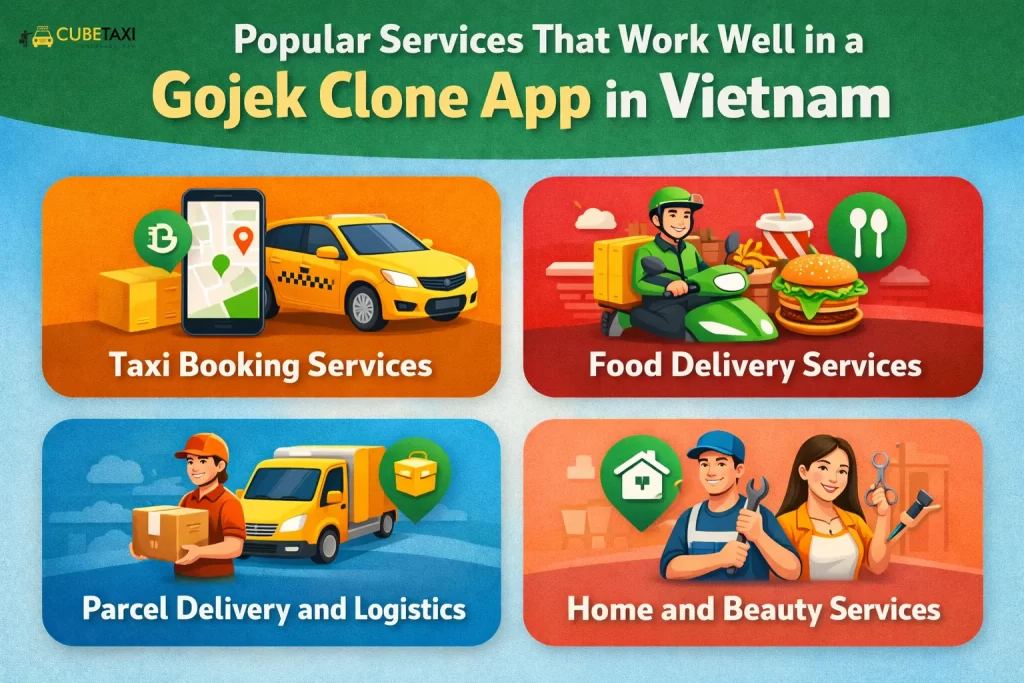
Ride-Hailing and Food Delivery Are the Most Profitable Services for a Gojek clone app in Vietnam. Super app service businesses also earn high margins on logistics, home services, and cosmetic care. The reason why these services are used almost everyday is because the market dominated Taxi Booking and ride delivery first and then shifted to high performing niches which were untapped. Let’s understand in detail.
Taxi Booking Services
Taxi booking services, popularly known as ride-hailing, is one of the most popular on-demand services in the world and Vietnam is no exception. The Vietnamese market was introduced with Taxi apps in 2014 when Uber and Grab entered the market. Today, almost everyone in Vietnam uses ride-hailing services. In fact, it’s believed that there’s no ride-hailing without super apps today. Zalo and Grab are the pioneers while new super apps are emerging.
Food Delivery Market
The food delivery market is huge in Vietnam. In 2024, the food delivery market of Vietnam was valued at $1.8 billion, with a whopping 26% YoY increase. The upward trend also showed that almost 30% of the Vietnamese respondents in the survey, order lunch via food delivery apps. The opportunity is yet growing and demands new competitors.
Parcel Delivery and Logistics
While Vietnam is becoming a country of trade and commerce, logistics for commercial activities and on-demand parcel deliveries are rapidly growing niches which still need active support. With Gojek clone apps in Vietnam, logistics can be much more organized and its potential is seen in the on-demand market of Vietnam.
Home and Beauty Services
If you’re launching a Gojek clone app in Vietnam, inducing beauty and home services isn’t just a profitable equation, it’s a growing niche which has potential worth millions of dollars. Home and beauty services are in a phase of digital transformation. Which means people are shifting to apps which offer good help in managing professionals and their calendars. This is exactly where the opportunity lies.
Benefits of Launching a Gojek-Like Multi-Service App Vietnam
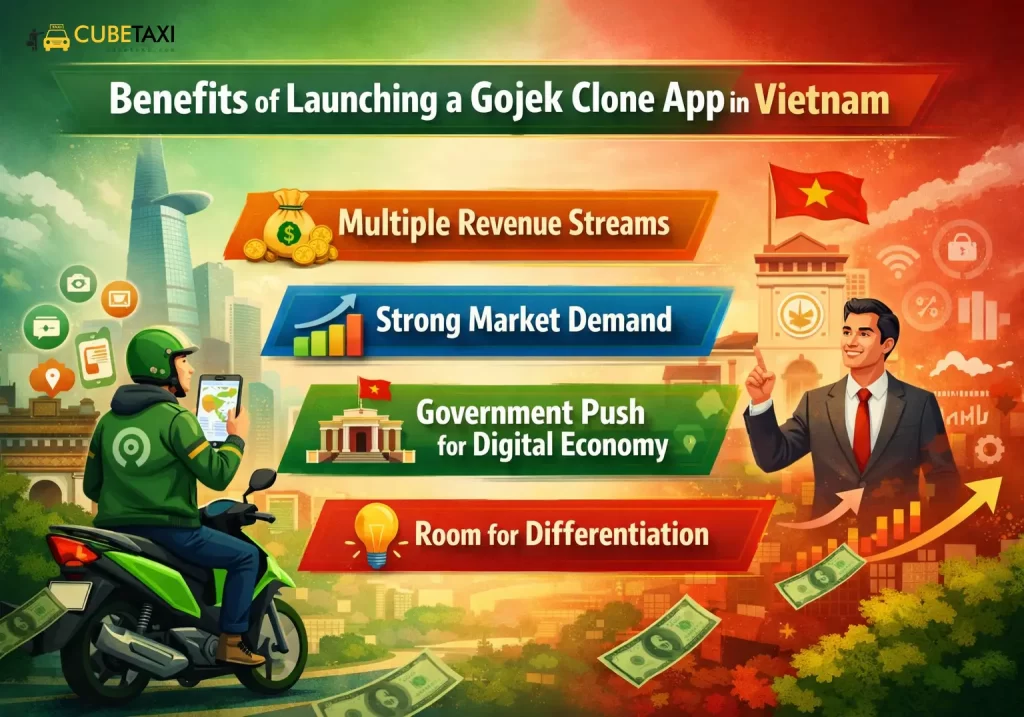
Gojek Clone app in Vietnam isn’t just a profitable opportunity, it is a legacy making chance. The opportunity exists because the market is strong and strategic, the government is investing in the digital economy, and there is room for differentiation. On top of it, the multi-revenue model supports the growth direction. Overall, it’s a win-win game, with visible growth. The risks are low, the time is correct, and the growth is right ahead of your eyes, it’s the time to seize the opportunity. Let’s understand it in detail.
Multiple Revenue Streams
The Gojek Clone app in Vietnam lets businesses make money from various sources, including delivery fees, ride commissions and service provider subscriptions and in-app advertisements. When more services are added to the platform, it can be a sustainable business model that provides a wide range of viable revenue opportunities.
Strong Market Demand
The on-demand economy of Vietnam is growing rapidly as consumers increasingly rely on mobile apps to access daily services. The food delivery and ride-hailing sector is now an industry worth billions of dollars and is proving that there is a huge demand for easy, mobile-based services.
Government Push for Digital Economy
Vietnam is actively working to promote its digital economy with policies supporting technology-driven startups, e-payments, as well as online platforms. This environment is supportive and helps business owners to make investments in the development of apps on demand and development in Vietnam and create large-scale super apps.
Room for Differentiation
Although there are many on-demand platforms, the market is still full of opportunities to innovate. Entrepreneurs can differentiate themselves through localized services, an improved user experience, as well as niche services. An appropriately-positioned Gojek Clone Application could help to tap into markets that aren’t served and create strong customer loyalty.
Future of Super Apps in Vietnamese Market
The future of super app businesses in Vietnam is rapidly growing. Gojek-like multi-service apps in Vietnam will have an optimum growth in emerging markets, such as Car Care, Healthcare, and Video consultations. On top of it, sustainable solutions like EV are being subsidized by the government. Currently, every niche is in growing demand which means the potential is yet to meet. If you ride the wave by starting your own Gojek clone app you can benefit from that potential. The goal is to implement optimized strategies to scale a super app business. Let’s understand it in detail.
Car Care
Car care solutions such as car cleaning, maintenance scheduling along with roadside help are growing possibilities in the Vietnam market for on-demand services. Incorporating these services in an integrated platform that offers multiple services allows super apps to extend their offerings and attract car owners.
Health Care
Medical services such as appointment with a doctor, delivery of medicine and diagnostic appointments can be incorporated into multi-service apps developed under Vietnam strategy. These options increase accessibility to medical services and allow super apps to develop into a high-demand digital services sector.
Video Consultations
Video consultations let users connect with experts such as consultants, doctors or service specialists via remote. This feature is added to the Gojek Clone to increase convenience and allow super apps to provide better and faster services.
EV Subsidization
Vietnam is slowly promoting the use of electric vehicles by providing incentives to encourage their use. The super app can take advantage of the incentives while promoting sustainable services to the environment and saving on long-term operating expenses.
So far, you’ve understood the complete market dynamics of the Gojek clone app. But development is still an issue. That’s exactly where white-label development comes in. Because who’d waste 18 months in development when you can launch in just 2 weeks. In the difference between Gojek clone and custom app development, Gojek clone apps always win in tough markets.
How Cube Taxi Helps Entrepreneurs to Launch a Multi-Service App in Vietnam?
Cube Taxi’s a Multi services app development company, who provides a ready-to-launch Gojek clone app. The complete software solution is already built, so you as an entrepreneur can just pick services, features you want to plug in, and customize the super app under your brand name. The complete process only takes 2 business weeks.
With over 1500 apps launched worldwide, Cube Taxi stands as a pioneer in white-label multi-service app development. 18 Niches, 101+ services, AI powered Advanced features, and powerful native tech stack are the foundation of their Gojek clone script. On top of that you get white-label perks like:
- 100% source code ownership
- Fully white-labelled apps, website, and admin panel
- Confidentiality protected by NDA
- Free tech support for 1 year
- 2 years of free app updates
To understand the complete Gojek clone app, you should take a look at Cube Taxi’s Gojek clone app demo. Experience the app in working and then launch it in just 2 weeks.
Conclusion
Vietnam is an ideal market for launching a Gojek clone in the near future. Vietnam has a massive smartphone market, rapid growth in digital payments, as well as growing on-demand purchases: factors which favor multi-service platforms that transform convenience into regular revenue. Entrepreneurs who take action now will take advantage of gaps in demand in cities of second-tier and leverage the strong wallet adoption and create viable cross-vertical lifecycles.
If you’re looking for a speedy way for super app development in Vietnam, a tested white-label Gojek clone app and a functioning Gojek clone app demo can reduce the technical risks and cut down the time from beginning to earning. The technology platform is important but what matters is the execution of local partnerships, driver and retailer economics, as well as product ease that converts first-time customers into regular customers.