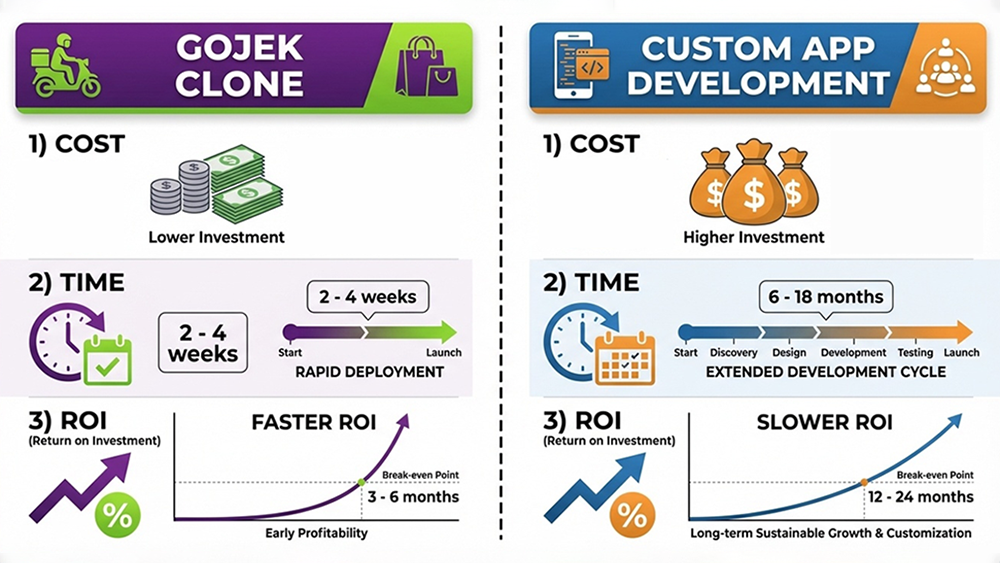
Introduction: Gojek Clone vs Custom App Development
Table of Contents
With the start of 2026, we are already seeing a shift in consumer behavior. Today, most people do not want to download too many apps and clutter their mobile devices. Instead, they want only the necessary apps, tailored to their individual needs. Now, when everything has come down to understanding the needs of the users, Multi-Service Apps are the growth engine everyone is looking forward to. In fact, economics proves it effectively. Research by Tamkang University Students, Yui-Hui Fang, Chien Hsiang Liao, and Chia-Yang Li on Super App LINE, features a ‘Synergy Effect’ that creates more profitability and reduces clutter, which directly indicates the psychological preference in choosing Super Apps like Gojek, LINE, and Grab.
But from the entrepreneurial perspective, the development of a Gojek-like Super App is quite new, regardless of their tech knowledge. Which always creates a heated debate—Gojek clone vs custom app development. While some say it’s impossible, others deny it. Some say it’s cheaper, some say it’s not worth it. Now, add a layer of marketing, and everything’s a messy omelette.
In short, it’s a big debate. So, in this blog, let’s end this debate about Gojek Clone vs Custom App Development
What is a Gojek Clone App?
A Gojek Clone is a Multi-Service application solution provided by the White-Label agency, which can be launched within 1-2 weeks with a simple development process. It’s a readymade solution, which means the experts create it and make it ready to be customized and launched. It comes with a complete business setup, which includes:
- Android & iOS Apps for Users
- Android & iOS Apps for Drivers & Service Providers
- Android & iOS Apps for Store Owners
- Android App for tracking
- Kiosk App for Food & Taxi
- Website & Admin Panel
- Supporting & Management Panels
This method usually lets you enter the market with ease without needing to hire developers and then investing time and energy into an app.
What is a Custom Multi-Service App?
Meanwhile, a Custom Multi-Service App means that you build every feature, every tap is designed from scratch. It’s a long route, usually the one with the most custom ability, but it comes at a cost. You invest more time and money in building the app.
It’s usually picked when people are either very tech-savvy or really scared of White-Label Apps. The usual understanding sits like Charles Darwin’s quote here: “Whenever I see a peacock’s tail, I feel sick!” This one line can help you understand why this exists.
With modern mechanisms and tech stacks, custom development agencies make sure your app works in the user logic you’re interested in. Revenue models that fit your business methods.
Cost Comparison: Gojek Clone vs Custom Development
The cost of an App like Gojek depends on 3 major factors, which define how much you’ll invest and how you’ll invest, Tech Stack, Development Timeline, and User Interface.
Let’s discuss each in detail.
1. Tech Stack
It means the combination of server, backend, APIs, and coding language that is used to write the codebase of the Gojek Clone App. The prominent tech stacks are Native, Flutter, and Django.
2. Development Timeline
Time is currency; the longer it takes to build an app, the more it costs because hiring teams to develop your app needs operational and hiring costs.
3. User Interface
User Interface Designers cost more than your business logic. The design of the premium User Interface is higher, causing the budget to increase.
Now, let’s put these principles into action and lay out a simple difference between the custom app and white-label solution.
The Cost Difference
| Aspect | Custom Multi-Service App | White-Label Gojek Clone |
| Tech Stack | Uses Flutter or Django | Native Tech Stack |
| Development Timeline | MVP Takes up to 6-8 months. Advanced App can take up to 2 years in complete development. | The launch process follows a 2 week development cycle. |
| User Interface | Customized costing | Product offers 3 different UI patterns |
Time to Market: Speed Matters
The timelines of the Gojek Clone and the custom Multi-Service App have a huge difference. This definitely raises doubts. But in reality, Gojek Clone is a completely fast-track launch model, and it’s genuine. This difference comes due to their pre-built technology. Instead of spending time, you just purchase a pre-built source code and customize it for your business model.
When we talk about Custom Apps, their timeline extends as they build everything from scratch. Every API, every integration costs you money and effort. In fact, the premium and advanced apps take much more time than MVPs. While an MVP takes 6-8 months, an advanced app like Gojek may take 12-18 months.
This is why founders usually prefer a White-Label Gojek Clone.
Feature Readiness & Scalability
One of the most crucial factors to consider in app development is the scalability of the app. It can make or break your business. The biggest decision yet isn’t the tech you choose, it’s the tech partner you choose. Scalability comes in Native Tech, while Flutter or Django are not reliable for speed and performance.
This is basic, now, if you look beyond that, scalability comes from future readiness. AI-Powered features & multiple currency & Language support make your Multi-Service App ready for expansion, while a tech partner that builds scalable and stable apps is more helpful. Good companies offer:
- Licensed Source Code
- Free Tech Support
- App Upgrades
- Milestone payments
These perks define their experience with their clients reflecting in perks. So, you need a good Tech partner regardless of whether you build or buy your Super App.
ROI Analysis: Which Option Delivers Faster Returns?
ROI has always been the most exciting part. Well, its significance in any business cannot be disputed. The returns in Gojek Clone and the Custom Multi-Service App are quite different. One can start in just 2 weeks, while the other takes months to just launch. This is where the Gojek Clone takes an upper hand.
It has different revenue streams that support its scaling business landscape. Let’s understand it.
How a Multi-Service App like Gojek Earns Money?
There are 8 revenue streams in a Multi-Service App ROI. Their major earnings come through commissions, cancellation fees, and surge pricing; however, they also have subscription plans for safety back, and high profitability methods like in-App advertising and priority listings.
Here’s the complete list:
- Commissions per booking
- Subscription plan for drivers/service providers
- Commission from stores
- Subscriptions from tracking apps.
- Priority listing fees
- In-App advertising
- Surge Pricing
- Cancellation Fees
Now, let’s put these into action. Let’s understand how a non-tech founder grew their Multi-Service App in Brazil.
Brazilian Gojek Clone Case Study
Brazil had no super apps that could cater to all on-demand services, which is why this app originated. The client told the white-label firm about the scam that a custom developer had committed. Then, he wanted a reliable app.
After using the White-Label script to launch his super app, he started marketing. This created a buzz. Today, his major revenue comes from commissions and surge pricing, which is around 40% because his services, like ride-hailing and food delivery, are very prominent. Almost 4000 rides and 2800 deliveries are made through his apps. While he also earns through Google Ads that are shown to users with minimal UI. Many service providers on its platform sell and buy cars and spend heavily on boosting their profile with priority listing.
What are the things you can observe from the same?
Case Study Observations: Risk vs Reward Comparison
The observations were as follows:
- Custom Developers have risky development timelines; someone could have stolen the idea, or, just like in this case, the app would be shabby.
- His choosing the White-Label script was about speed to market and how quickly he could generate business out of it.
- Using marketing knowledge, he was able to secure a good scale and is growing significantly.
This is the power of speed to market: you get a fast launch and faster returns. At the same time, your competitors make their unique logic, you have made money and already scaled to 5-7 cities.
When Should You Choose a Gojek Clone App?
Gojek Clone is a simply very accurate option for people with a limited budget. However, there’s a much more layered tip even if you have a good budget. The following tells us exactly who should choose Gojek Clone.
Early Founders and Startups that Want Expansion
People who want speed, you cannot agree more that the Gojek Clone is one of the very fast app development routes. The 2-week launch timeline exactly removes the hassle and effort, reducing the time and bandwidth. This is the absolute product that can be considered as a complete business solution if you want early launch and early returns.
Business Which Need Budget-Friendly Solution
People who have been in a certain on-demand industry and want to launch a reliable app within a certain budget, you should definitely choose Gojek Clone. The reason is that it’s almost a fraction of the cost you pay in custom app development, while completely getting a proven model that you know works in real-time.
When Does Custom Development Make Sense?
Custom Development makes sense when you put it in the fraction where you need very unique logic or a business model. This is exactly who should be the one choosing Custom Development!
Highly Unique Business Logic
If you want to innovate your new user flow or have a certain business logic for your app, then you can definitely choose custom development, as they have limited customizability from the perspective of the business model.
Enterprise-Level Constraints
If you’re someone who has been catering to a lot of on-demand niches and already have a ready business setup, this is when you need a custom development agency, because they’d create a highly unique UI based on your needs for invoicing and management, like a POS software.
Final Verdict: Gojek Clone vs Custom Multi-Service App
There is no choice between right and wrong here. You’re deciding the right combination of speed and customization. The smarter option is based on the situation of your company now and where you would like it to be in the future.
If you want to test your idea quickly or to enter the market prior to competitors and begin to build revenue streams with minimal technical risk, a Clone is a structured, efficient, reliable, and quicker route to launch. It allows you to focus on marketing, operations, and growth, rather than being stuck in lengthy development cycles.
But, if your dream calls for a highly specialized environment or a unique flow of services, or an operational system that is enterprise-grade, the custom development process becomes an investment in the long run that creates a distinctive brand name and a technologically-driven ownership.
The most successful business decisions aren’t always concerned with following trends. They’re about identifying options that are able to balance speed, risk and long-term sustainability. If they are paired with the appropriate technology partner and growth strategy, each approach can be successful in transforming your multi-service app idea into a digital enterprise that is scalable.